Easter Sunday
5 April
By Johannes
A lay Catholic voice reflecting within the life of the parish
Easter Sunday – The Resurrection of the Lord
5 April
Easter Sunday is the greatest and most joyful feast in the Christian calendar. On this day the Church proclaims the central truth of the Christian faith: Jesus Christ has risen from the dead. After the sorrow of Good Friday and the silence of Holy Saturday, the Church celebrates the victory of Christ over sin and death.
The celebration of Easter begins during the Easter Vigil, the most solemn liturgy of the entire year. As the Vatican reflection explains:
“There are no liturgical celebrations in the Church on Saturday. In the Middle Ages, an erroneous interpretation led to anticipating the Easter Vigil, the ‘Mother of all vigils’, to early on Holy Saturday morning. Pope Pius XII in 1951 and in 1955 reestablished the ancient order, which was then put into the new Missal in 1970. In this most holy night, the ‘Church waits, keeps vigil for the resurrection of Christ and the celebration of the sacraments.’ ”
During the Easter Vigil, the Church gathers in darkness and begins with the Service of Light. The fire is blessed, the Paschal Candle is lit, and the faithful enter the church in procession as the light spreads through the assembly.
The Vatican text describes this moment:
“The Service of Light consists of the blessing of the fire, the lighting of the paschal candle and the entrance into the church, up until the chanting of the Exultet.”
The liturgy continues with the proclamation of Scripture. The history of salvation is recalled through readings from the Old Testament, followed by the proclamation of the Resurrection.
“The Liturgy of the Word, consists of listening to seven readings from the Old Testament, one reading from Saint Paul, and the Easter Gospel. The story of salvation unfolds God’s faithfulness regarding his people.”
The Vigil then moves to the Baptismal Liturgy, recalling that through Baptism Christians share in the death and resurrection of Christ.
“The Baptismal Liturgy, consists of the Sacrament of Baptism for adults, or the blessing of the water, followed by the renewal of baptismal promises and the sprinkling with the blessed water.”
Finally, the Church celebrates the Eucharistic Liturgy, the first Mass of Easter.
“The Eucharistic Liturgy, through which, with the celebration of the sacrament, we are made contemporaries of Jesus through His command, ‘Do this is memory of me’, and our response, ‘We proclaim your death, O Lord, and profess your Resurrection until you come again.’ ”
Through this liturgy the Church enters into the joy of the Resurrection.
“Easter Sunday is already celebrated during the night. The Masses on Easter Day are a prolongation of joy, of awe, aware that what is ‘essential is invisible to the eyes’.”
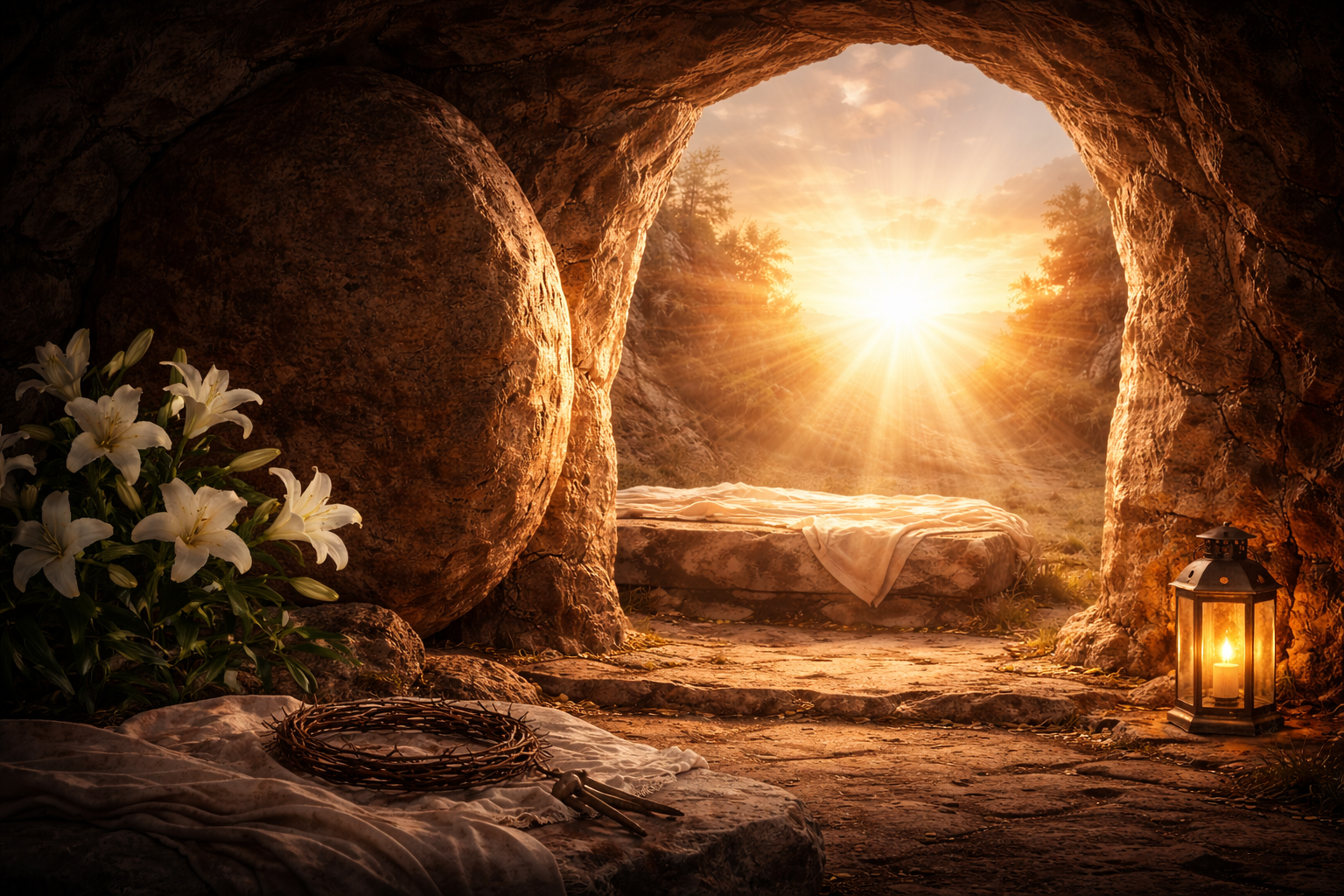
The Gospel of Easter proclaims the discovery of the empty tomb and the first announcement that Christ has risen:
“After the sabbath, as the first day of the week was dawning, Mary Magdalene and the other Mary came to see the tomb. And behold, there was a great earthquake; for an angel of the Lord descended from heaven, approached, rolled back the stone, and sat upon it. His appearance was like lightning and his clothing was white as snow. The guards were shaken with fear of him and became like dead men.
Then the angel said to the women in reply, ‘Do not be afraid! I know that you are seeking Jesus the crucified. He is not here, for he has been raised just as he said. Come and see the place where he lay. Then go quickly and tell his disciples, “He has been raised from the dead, and he is going before you to Galilee; there you will see him.” Behold, I have told you.’
Then they went away quickly from the tomb, fearful yet overjoyed, and ran to announce this to his disciples. And behold, Jesus met them on their way and greeted them. They approached, embraced his feet, and did him homage. Then Jesus said to them, ‘Do not be afraid. Go tell my brothers to go to Galilee, and there they will see me.’ ”
(Mt. 28:1–10)
The Resurrection of Christ is not only an event of the past but a living reality that transforms the world. The Vatican reflection expresses this in a powerful way:
“Jesus, the Risen One, has given us the gift of fraternity. He is alive! And He walks with us. The gift that Jesus gave us by dying on the cross and rising on the third day is that of a new humanity founded on fraternity.”
This new life in Christ calls believers to unity and love.
“Fraternity is not a given, but is constructed day after day: ‘as you, Father, are in me and I in you, that they also may be one in us, that the world may believe’ (Jn. 17:21).”
The joy of Easter therefore invites Christians to live as witnesses of Christ’s love in the world. The Vatican reflection concludes with this encouragement:
“May the joy of the Risen Jesus be a stimulus to everyone to learn how to love each other well: in the family, at work, playing sports, in free time, in the parish…. Jesus, the Lord, is risen.”
Easter proclaims the greatest hope of the Christian faith: Christ is risen. Alleluia.