Feast of the Presentation of the Lord
2nd February
By Johannes
A lay Catholic voice reflecting within the life of the parish
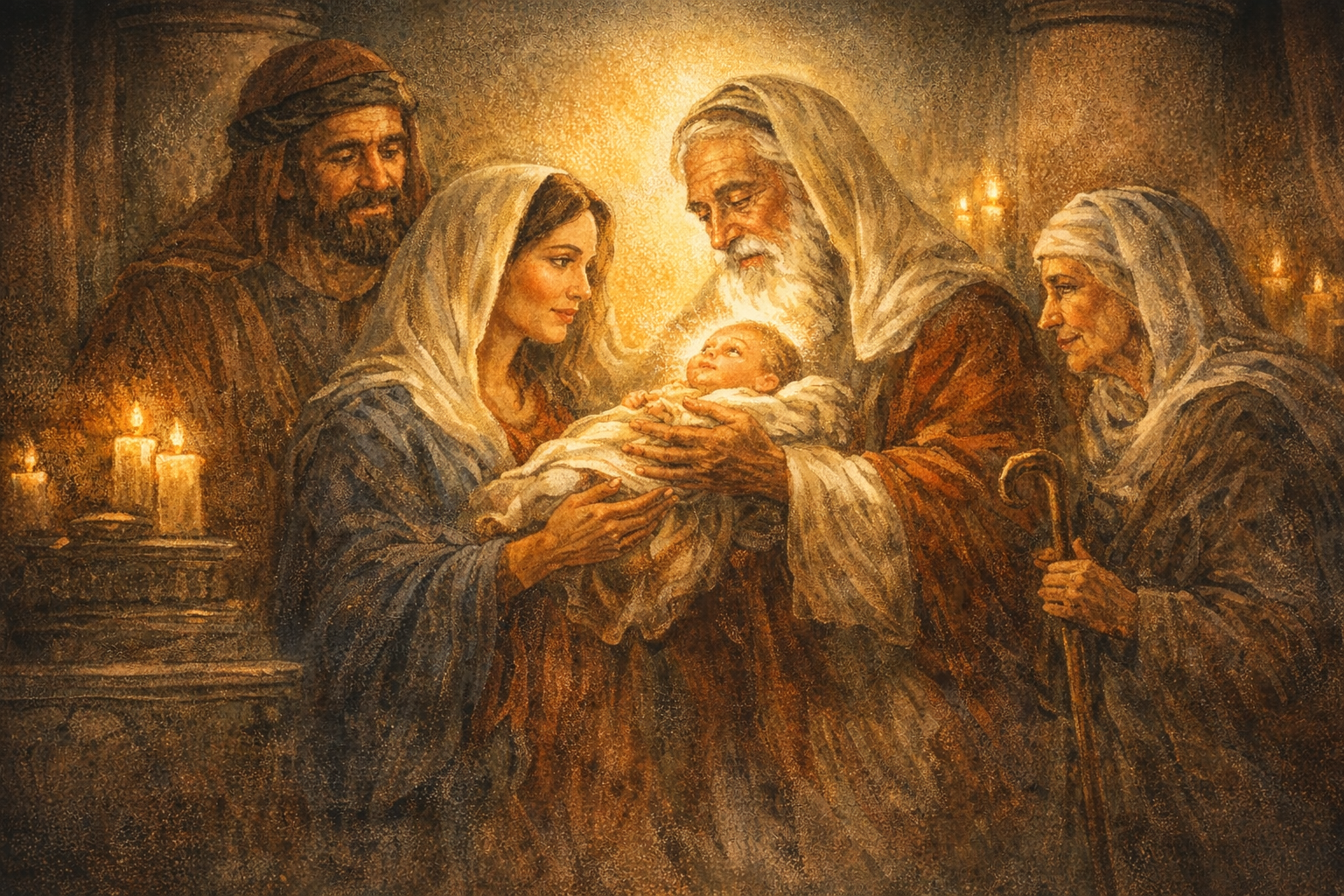
Forty days after Christmas, the Church celebrates the Feast of the Presentation of the Lord. According to the Law of Moses, every first-born male belonged to the Lord and was to be presented in the Temple, with an offering made on the child’s behalf. Mary and Joseph obey this law faithfully, offering the sacrifice of the poor — two turtledoves. The Son of God enters the Temple not with privilege or exemption, but by submitting fully to the religious life and obligations of his people.
For us today, this moment speaks of faithfulness in ordinary obedience. In a culture that values autonomy and choice above all else, the Presentation reminds us that faith is not self-definition, but trust — a willingness to place our lives within God’s order, even when that obedience appears unremarkable or unseen.
This feast was known in the early Church as the Feast of the Meeting. In the Temple, God meets his people, and humanity encounters its salvation — quietly, without spectacle. Jesus is not recognised by officials or religious authorities, but by two elderly figures, Simeon and Anna, whose lives have been shaped by long waiting, prayer, and attentiveness to God.
Here the feast speaks directly to our time. We are often impatient with waiting and uncomfortable with silence. Simeon and Anna show that spiritual vision is formed over time, through perseverance rather than immediacy. They see what others miss because they have learned to wait.
Simeon, moved by the Holy Spirit, recognises Jesus as the fulfilment of God’s promise. Taking the child into his arms, he proclaims him “a light for revelation to the Gentiles and glory for Israel”. Light, however, is never neutral. It reveals truth and exposes what is hidden. Simeon makes clear that this child will be a sign of contradiction — welcomed by some, rejected by others.
This is a sharp challenge for today. Faith is often expected to be comforting but not demanding, private but not challenging. The Presentation reminds us that Christ’s light does not simply reassure; it asks us to take a stand, even when that leads to misunderstanding or opposition.
Simeon then speaks directly to Mary, foretelling that a sword will pierce her heart. From the beginning, joy and suffering are intertwined. The Gospel does not promise believers a life free from pain, but a life in which suffering is not meaningless. For a world that struggles to understand suffering, this feast reminds us that love, truth, and fidelity always carry a cost.
Anna, the prophetess, confirms what Simeon has recognised. Elderly, widowed, and devoted to prayer and fasting, she discerns the presence of God where others see only an ordinary child. She speaks openly about Jesus to those longing for redemption. Her witness shows that prophecy is not prediction, but the courage to name God’s presence in the present moment.
Today, this challenges us to ask whether we are willing to speak about faith openly and intelligently, or whether we keep it safely silent.
Finally, Luke tells us that Mary and Joseph are amazed, and that Mary treasures these things in her heart. She does not fully understand, yet she trusts. In an age that demands instant answers and certainty, the Presentation reminds us that faith often means holding questions without abandoning trust.
The Feast of the Presentation therefore speaks powerfully to our own time. It calls us to attentiveness, courage, patience, and honesty before the light of Christ — a light that continues to enter the world quietly, revealing truth and asking each generation how it will respond.