Memorial to Our Lady of Lourdes
11 February
BY Johannes
A lay Catholic voice reflecting within the life of the parish
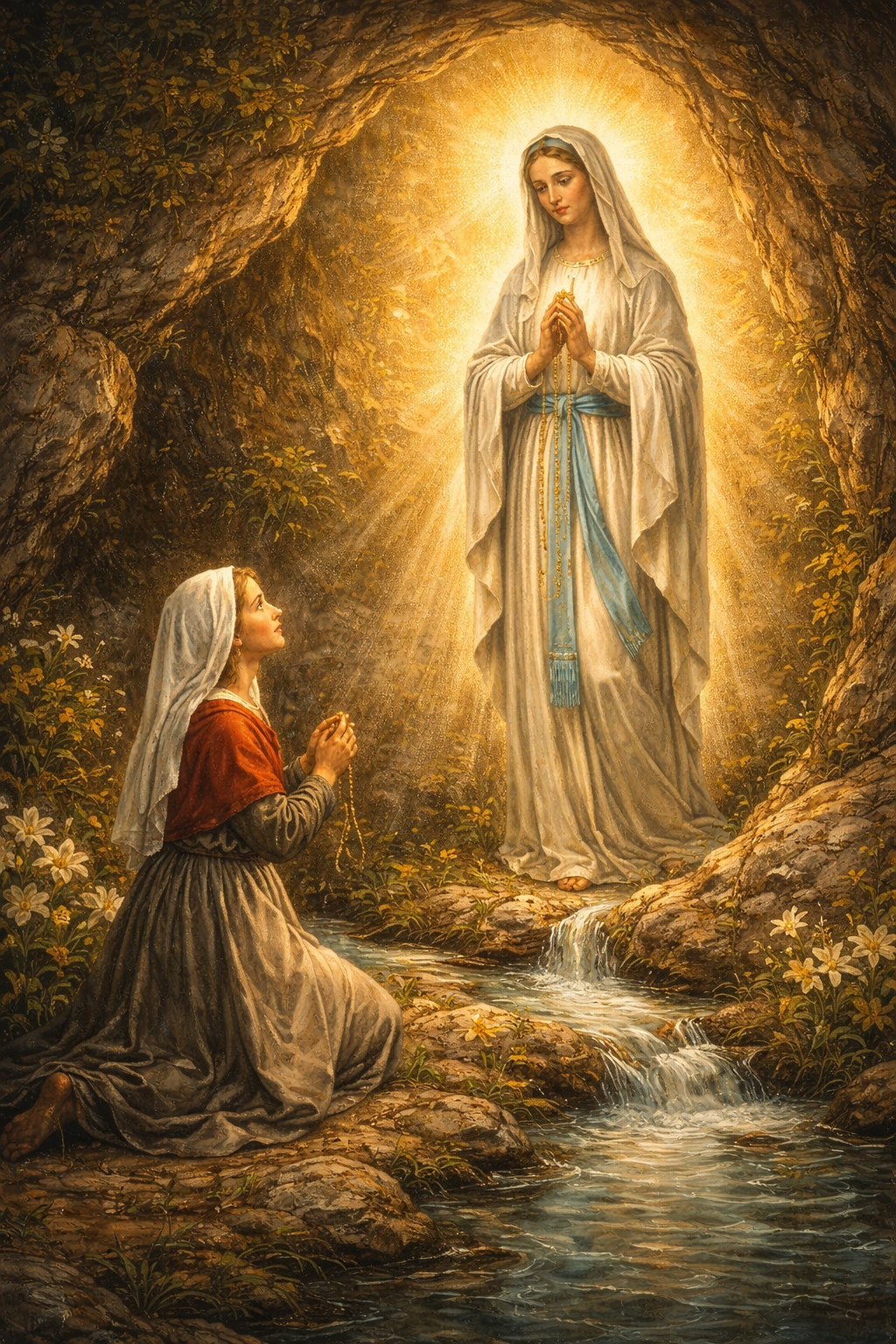
Today’s liturgical memorial recalls the apparitions of the Virgin Mary at Lourdes, which began on 11 February 1858. The apparitions were experienced by a young, poor, and uneducated girl, Bernadette Soubirous, who would later be recognised as a saint. Mary appeared to her eighteen times at a grotto beside the River Gave, on the outskirts of Lourdes, in southern France. These events were carefully examined by the local diocesan authorities and were officially recognised by the Bishop of Tarbes in 1862.
The circumstances of the first apparition are striking in their simplicity. Bernadette was by the river with other girls when she heard what she described as a “gust of wind”, though the trees were still. Approaching the grotto, she saw a lady dressed in white. Unsure whether what she was seeing was real, she rubbed her eyes. The figure remained. Bernadette instinctively reached for her rosary and began to pray, and the Virgin joined her in prayer. From the very beginning, the message of Lourdes is inseparable from prayer, humility, and trust.
In later apparitions, Mary asked Bernadette to return to the grotto for fifteen days, and to perform acts of penitence. One of the most misunderstood moments occurred when Bernadette was instructed to eat weeds and drink from a muddy puddle. Only later did a clear spring emerge from the spot she had dug with her hands. This spring continues to flow today and has become a powerful sign of purification, healing, and hope.
On 25 March, Mary revealed her identity with the words “I am the Immaculate Conception”, confirming a dogma proclaimed only four years earlier by Pope Pius IX. This declaration, beyond Bernadette’s education or understanding, became a decisive moment in the Church’s recognition of the apparitions.
Lourdes is known not primarily for the apparitions themselves, but for its enduring mission as a shrine for the sick. Tens of millions of pilgrims have come seeking peace, healing, and consolation. While only seventy healings have been officially recognised after rigorous medical investigation, countless others speak of spiritual renewal, conversion, and restored hope.
The Church sees a deep connection between Lourdes and the Gospel scene of the Wedding at Cana. At Cana, Mary notices human need and quietly intercedes: “They have no wine.” She entrusts that need to her Son and instructs others to do whatever he tells them. At Lourdes, Mary continues this maternal role — drawing attention not to herself, but to Christ, the only one who can transform suffering, weakness, and loss into new life.
For this reason, Pope Saint John Paul II chose 11 February as the World Day of the Sick. Lourdes reminds us that those who are ill or vulnerable are never disposable, never marginal, and never forgotten by God. In a world that often fears weakness or hides suffering, this memorial calls the Church to stand visibly alongside those who suffer in body or spirit, affirming their dignity and their place at the heart of the Christian community.
Today’s memorial therefore speaks clearly to our own time. It challenges us to recognise God’s work in humility rather than spectacle, to trust in prayer, and to remain attentive to the needs of the weakest. Lourdes teaches that hope does not deny suffering, but accompanies it — and that Christ still transforms water into wine, despair into trust, and human fragility into a place of grace.