World Focus
Saint Pio of Pietrelcina – A Saint of Prayer, Suffering and Mercy
by John Maffin
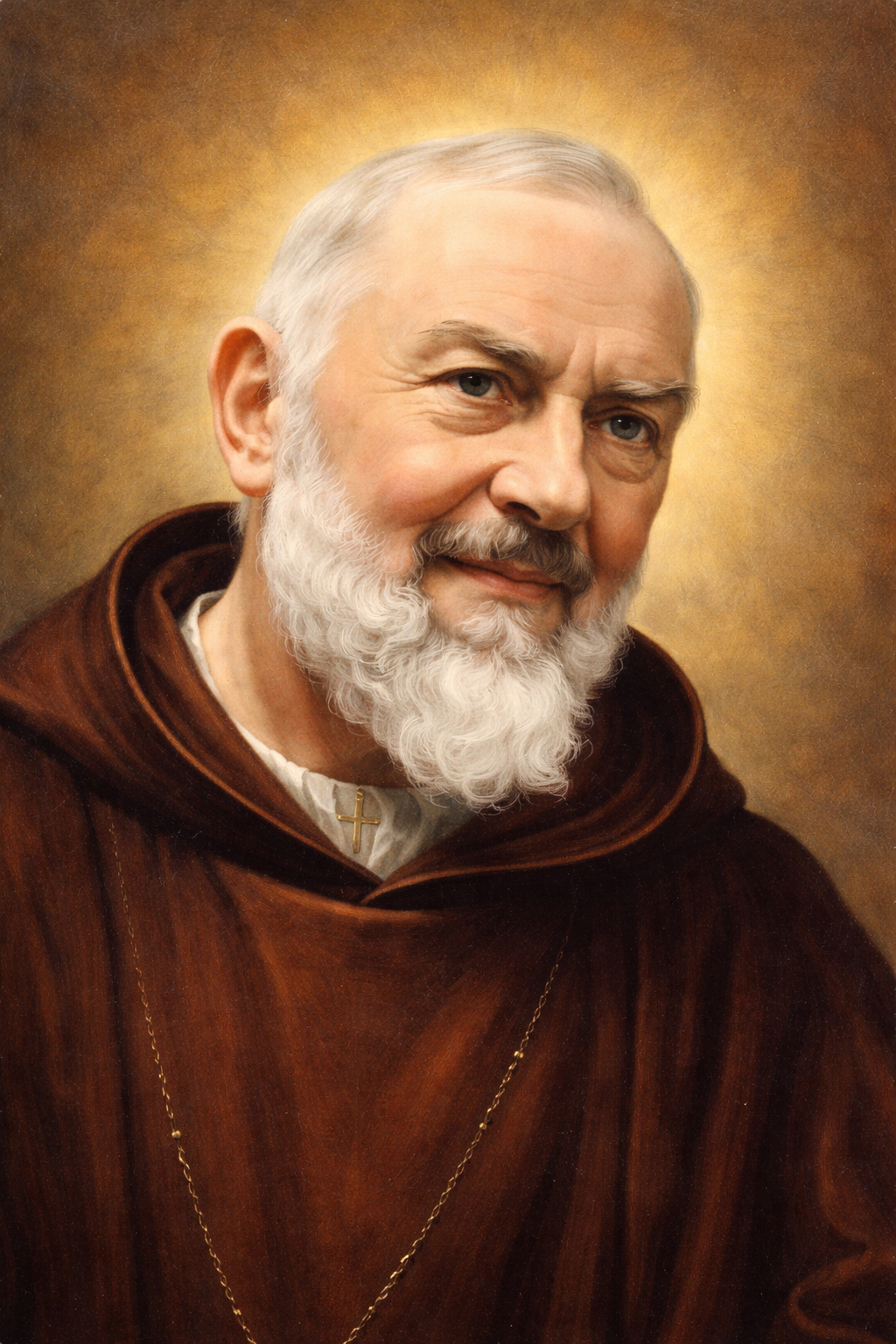
Illustrated portrait of Saint Pio of Pietrelcina
Saint Pio of Pietrelcina, widely known throughout the world as Padre Pio, was one of the most recognisable and influential Catholic saints of the twentieth century. His life, marked by prayer, humility, and deep compassion for those who suffered, continues to inspire millions of people across cultures and generations.
Saint Pio was born Francesco Forgione on 25 May 1887 in the small rural town of Pietrelcina in southern Italy. Raised in a poor but deeply Catholic family, he learned from an early age the importance of prayer, trust in God, and perseverance through hardship. Even as a child, Francesco showed a strong attraction to the Church and a desire to dedicate his life entirely to God.
At the age of 15, he entered the Capuchin Franciscan Order, a branch of the Franciscan family known for its emphasis on simplicity, prayer, and closeness to ordinary people. He took the religious name Pio and was ordained a priest in 1910. His early priesthood was marked by fragile health, including serious illness, which limited his ability to travel or take on demanding pastoral roles. Instead, he was assigned to the friary at San Giovanni Rotondo, a quiet hill town that would later become a place of pilgrimage for the faithful from around the world.
In 1918, while praying after Mass, Saint Pio received the stigmata — the visible wounds corresponding to those suffered by Christ during the Crucifixion. These wounds remained with him for the rest of his life. Their appearance attracted both devotion and scrutiny, and the Church carefully investigated the phenomena over many years. Throughout this period, Saint Pio responded with obedience, patience, and humility, accepting restrictions placed upon him and continuing to live a hidden life of prayer.
At the heart of Saint Pio’s vocation was the Sacrament of Reconciliation. He spent countless hours each day in the confessional, sometimes for ten to fifteen hours at a time, welcoming penitents from all walks of life. Those who encountered him often spoke of his directness, honesty, and deep concern for the salvation of souls. His ministry of confession was not about harsh judgement, but about calling people back to truth, conversion, and the mercy of God.
Saint Pio was also deeply devoted to the Eucharist, celebrating Mass with profound reverence. For him, prayer was not an abstract idea but a living relationship with Christ, sustained through daily fidelity and sacrifice. He encouraged people to pray regularly, to remain close to the sacraments, and to unite their sufferings with those of Christ.
His concern for the sick and the suffering took a very practical form with the founding of the Casa Sollievo della Sofferenza — the House for the Relief of Suffering — which opened in 1956. This hospital, established through donations from the faithful, reflected Saint Pio’s conviction that Christian charity must be lived out in action. It remains an important medical and research centre today.
Saint Pio’s life was not free from misunderstanding or trial. For periods of time, Church authorities restricted aspects of his public ministry while investigations continued. He accepted these decisions in obedience, never turning away from the Church he loved. In later years, those restrictions were lifted, and his reputation for holiness grew steadily, grounded in the quiet consistency of his daily faithfulness rather than extraordinary events.
He died on 23 September 1968, having spent more than fifty years at San Giovanni Rotondo. In the years following his death, devotion to him spread rapidly. After careful examination of his life and virtues, the Church declared him Blessed in 1999, and he was canonised by Pope Saint John Paul II on 16 June 2002. His feast day is celebrated each year on 23 September.
Today, pilgrims continue to visit San Giovanni Rotondo, where Saint Pio’s tomb is located, seeking prayer, consolation, and renewed faith. His legacy is not found only in extraordinary signs, but in his unwavering commitment to prayer, obedience, and compassion.
Why Saint Pio Matters Today
Saint Pio’s life speaks powerfully to the modern world. In an age often marked by distraction, suffering, and uncertainty, he reminds us that holiness is found in faithfulness to daily prayer, trust in God during trials, and love for others expressed through service and mercy. His witness encourages us to approach the sacraments with sincerity, to persevere when faith feels difficult, and to believe that no suffering is wasted when placed in God’s hands.
The video featured on this page, “Saint Pio of Pietrelcina: Man of Hope and Healing,” is a Catholic docudrama produced in collaboration with EWTN and the Saint Pio Foundation. It presents his life with reverence and historical care, drawing on authentic testimony and Church-approved sources. It offers an opportunity to reflect more deeply on a saint whose quiet faith continues to touch hearts across the world.
Saint Pio’s life invites each of us to return to the essentials of the Christian life: prayer, repentance, charity, and hope — lived not in grand gestures, but in steady, faithful love