Feast of the Visitation of the Blessed Virgin Mary
By Johannes
A lay Catholic voice reflecting within the life of the parish
There are visits, and there are visits.
Some visits are carefully planned. Diary checked, kettle ready, best biscuits found from the back of the cupboard. Other visits happen because something inside us says, go now. No committee, no minutes, no sub-group. Just love, moving quickly.
That is the Feast of the Visitation.
Mary has received the message of the angel. She is to be the Mother of the Lord. It is the most astonishing news ever given to a human being. And what does she do? She does not sit still polishing her halo. She does not start a blue folder marked “Messiah: Personal Project”. She goes.
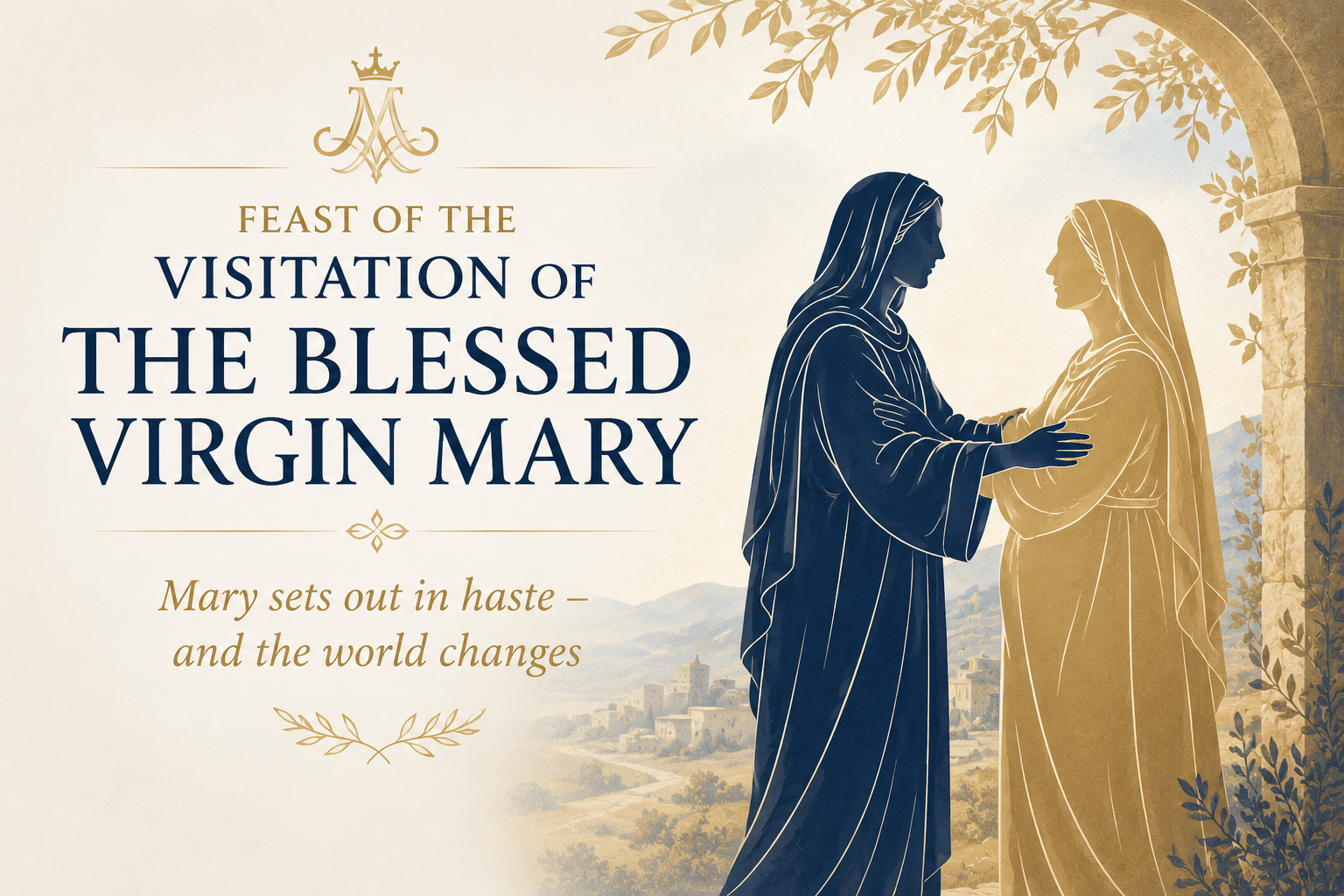
St Luke tells us: “Mary set out and traveled to the hill country in haste to a town of Judah, where she entered the house of Zechariah and greeted Elizabeth.” When Elizabeth hears Mary’s greeting, the child in her womb leaps, and Elizabeth, filled with the Holy Spirit, cries out: “Most blessed are you among women, and blessed is the fruit of your womb.” — Luke 1:39–42
That is the Gospel scene at the heart of this feast: two women, two unborn children, one house filled suddenly with grace.
The Vatican reflection on the Visitation reminds us that the feast has a long history. It was adopted by the Franciscans in 1263, later established more widely by Pope Urban VI in 1389, and after the liturgical reform of the Second Vatican Council it was fixed on 31 May, at the end of the month traditionally dedicated to Mary. It is a beautiful way to close the month of May: not with Mary standing alone, but with Mary going out in love.
And that is the point.
Mary’s first journey after the Annunciation is not towards status, comfort or attention. It is towards service. Elizabeth is older, pregnant, and perhaps in need of help. Mary goes in haste because love does not always move at a leisurely pace. Sometimes love gets its coat on and goes.
Every parish understands this. At St Charles, faith is not only what happens at the altar, though it begins and is nourished there. Faith also happens in the quiet visit, the phone call, the lift offered, the candle lit for someone else, the cup of tea poured without fuss, and the steady kindness of people who notice when someone is missing.
The Visitation also reminds us that God is often recognised in meeting. Elizabeth recognises something holy in Mary. John the Baptist, still hidden in the womb, leaps for joy in the presence of Christ. No sermon has yet been preached. No miracle has yet been worked. No public ministry has begun. But Christ is already present, and joy has already started.
That is wonderfully Catholic. We believe God comes to us through signs, sacraments, people, bodies, homes, meals, greetings and ordinary human kindness. Grace does not float vaguely above life. It enters the room.
There is also something very human here. Mary may have gone to serve Elizabeth, but perhaps she also went because Elizabeth would understand. The Vatican reflection notes that Mary may have wished to speak with another woman who had also been “visited” by an angel. There are times when faith needs another person: someone who will not laugh, dismiss, or reduce everything to common sense. Someone who can say, in effect, “Yes. God is at work here.”
For us, the Visitation is an invitation. Do not keep Christ to yourself. Carry him quietly, gently, faithfully, into the lives of others. Visit. Encourage. Listen. Help. Notice. Rejoice.
Mary went in haste.
Not because she was panicking.
Not because she was late for Mass.
But because love had begun its journey.
And wherever Christ is carried with humility, joy is never far behind.
Amen.