A Pentecost Reflection
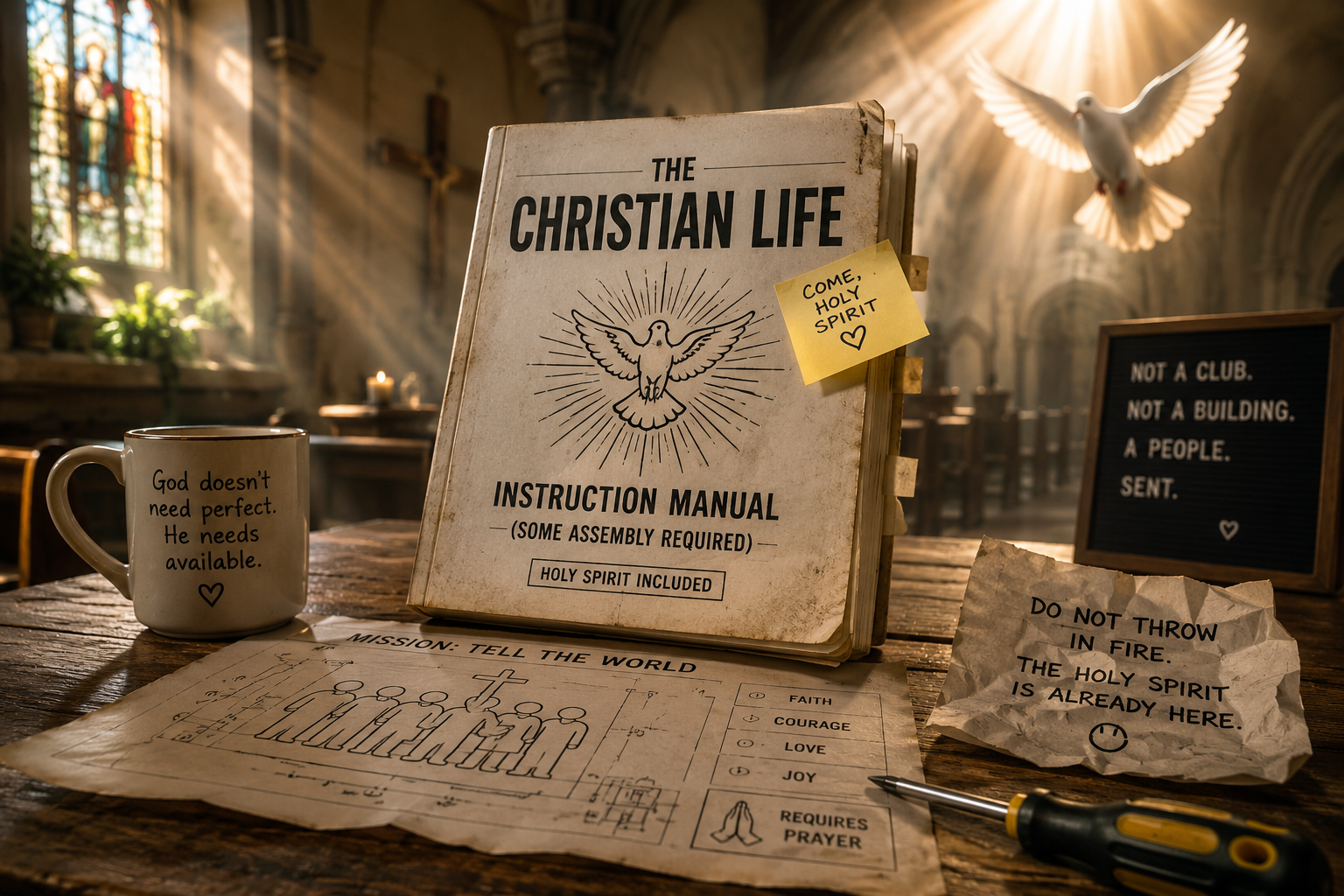
“Read the Instructions”
By Johannes
A lay Catholic voice reflecting within the life of the parish
There are two kinds of people in this world when it comes to reading instructions.
There are those, examples to us all, who read the instructions first, and there are people who throw the instructions away, press three buttons, break the appliance, and then say, “It must be faulty.”
Most of us, if we are honest, live somewhere in the middle. We want the thing to work, but we do not want to read thirty-seven pages of small print written by someone who clearly loves writing small print - probably to save ink or maybe a pedant of some sort.
And sometimes, I think, we approach the Christian life rather like that.
We want peace. We want meaning. We want courage. We want faith. We want the Church to be alive. We want our families to be healed. We want the world to be less mad. But we are not always quite so keen on reading the instructions.
Pentecost is the moment when God does not simply hand the Church an instruction manual.
He gives her power.
Not power in the worldly sense. Not the power of status, job titles, buildings, money, or the ability to speak for twenty minutes at a meeting without once approaching the point. Pentecost gives the Church the power of the Holy Spirit.
And that is something very different.
Before Pentecost, the apostles were, to put it kindly, not an impressive launch team.
They were frightened. They were hiding. They had locked the doors. These were the men who had promised loyalty to Jesus and then scattered like pigeons when things got dangerous. Peter, their leader, had denied even knowing him. Thomas had doubted. The others had mainly kept their heads down.
If you were starting a worldwide Church, you might not begin with this group.
You might want better public speakers. A few people with legal training. Someone good with spreadsheets. A social media person, perhaps? At least one reliable adult who knows where the keys are.
But Jesus chose them.
And more than that, he trusted them with his mission.
That is either madness, or it is grace.
Pentecost tells us it is grace.
The Holy Spirit comes upon them not because they are already brave, polished, reliable and impressive. The Spirit comes because they are weak, afraid, forgiven and available. God does not wait until they are perfect. If he did, the Church would still be in the upper room with a flipchart saying, “Mission postponed pending further personal development.”
Instead, the Spirit comes as wind and fire.
Wind, because the Church needs breath.
Fire, because the Church needs courage.
And both, because faith is not meant to sit there looking respectable.
That is one of the great temptations of religion: to make it respectable. Safe. Decorative. Something we bring out on Sundays, like polished shoes or the good coat. We can become very good at looking Catholic. We can know when to stand, sit, kneel, bow, respond, genuflect, and glance disapprovingly at someone whose phone has gone off during the consecration.
But Pentecost is not about looking Catholic.
It is about becoming alive in Christ.
That is much more dangerous.
A living Church cannot be reduced to buildings, rotas, newsletters and notices about where the sign-up sheet is. Useful though those things are, especially if anyone ever finds the sign-up sheet.
A living Church is where the Holy Spirit is allowed to disturb us.
And most of us do not like being disturbed. We prefer God to be comforting, but not too challenging. Near enough to bless us, but not so near that he starts rearranging the furniture of the soul.
But the Holy Spirit does rearrange the furniture.
He moves fear out of the centre and puts courage there. He pushes pride into the corner and brings mercy forward. He opens windows we nailed shut years ago. He turns locked rooms into doorways.
That is what happened at Pentecost.
The apostles had been hiding inside. After the Spirit came, they went outside.
That little movement matters. Inside to outside. Fear to witness. Silence to proclamation. Survival to mission.
And perhaps that is the journey every parish must make again and again.
Because every parish can become an upper room. Comfortable, familiar, slightly anxious, full of people who know one another, and not entirely sure what to do about the world outside.
The world outside, meanwhile, is not waiting politely.
It is noisy, lonely, confused, angry, funny, wounded, distracted, addicted to screens, allergic to boredom, suspicious of institutions, and yet still hungry for God, even when it does not know his name.
People are searching everywhere. In wellness apps, podcasts, politics, shopping baskets, gym memberships, conspiracy theories, dating sites, self-help books and videos titled “Ten Ways to Transform Your Life Before Breakfast.”
And here is the Church, with the treasure of Christ, sometimes behaving as though the most urgent question is whether the hymn book trolley has been put back properly.
Pentecost will not let us off so lightly.
The Holy Spirit sends the Church into the real world.
Not into an imaginary holy world where everyone speaks gently and nobody parks badly. The real world. The world of family tensions, unpaid bills, hospital appointments, grief, resentment, humour, tiredness, hope, and people trying their best while pretending they are coping.
That is where the Spirit sends us.
And notice the miracle: people hear the apostles in their own language.
That is extraordinary. Pentecost is not God forcing everyone to speak church language. It is God enabling the Church to speak in a way people can actually understand.
That may be one of the greatest needs of our time.
Can we speak so that the young hear more than rules?
Can we speak so that the wounded hear more than judgement?
Can we speak so that the lonely hear welcome?
Can we speak so that the guilty hear mercy?
Can we speak so that the bored hear wonder?
Can we speak so that people who have drifted away hear not, “Where have you been?” but, “We are glad you are here”?
That is Pentecost language.
It is not clever. It is not fashionable. It is not vague. It is the language of love, truth, mercy and courage.
And it begins not with a microphone, but with a heart surrendered to God.
“Come, Holy Spirit” is a dangerous prayer.
We sometimes say it as though we are asking for a mild improvement in the atmosphere. A little spiritual air freshener. Something lavender-scented to make the parish feel calmer.
But “Come, Holy Spirit” means: set fire to what is dead in me. Breathe life into what is tired. Burn away what is false. Make me brave where I am cowardly. Make me humble where I am proud. Make me loving where I am cold. Make me useful where I have become comfortable.
That is not a small prayer.
It is the prayer of a Church that wants to live.
So perhaps, this Pentecost, we should not simply ask whether we believe in the Holy Spirit.
We should ask whether we are willing to be changed by him.
Because the Holy Spirit is not an ornament of the faith. He is God alive in us.
He is the breath in the Church’s lungs.
He is the fire in the Church’s heart.
He is the courage of the frightened.
He is the mercy of the forgiven.
He is the voice that sends ordinary people into ordinary streets carrying extraordinary grace.
The apostles began behind locked doors.
By the end of the day, the doors were open, the message was out, and the world had begun to change.
Not bad for a group of frightened men with no plan, no budget, no website and no obvious idea what they were doing.
But they had the Holy Spirit.
And so do we.
Come, Holy Spirit.
Wake us up.
Send us out.
And for heaven’s sake, help us read the instructions.
Amen.