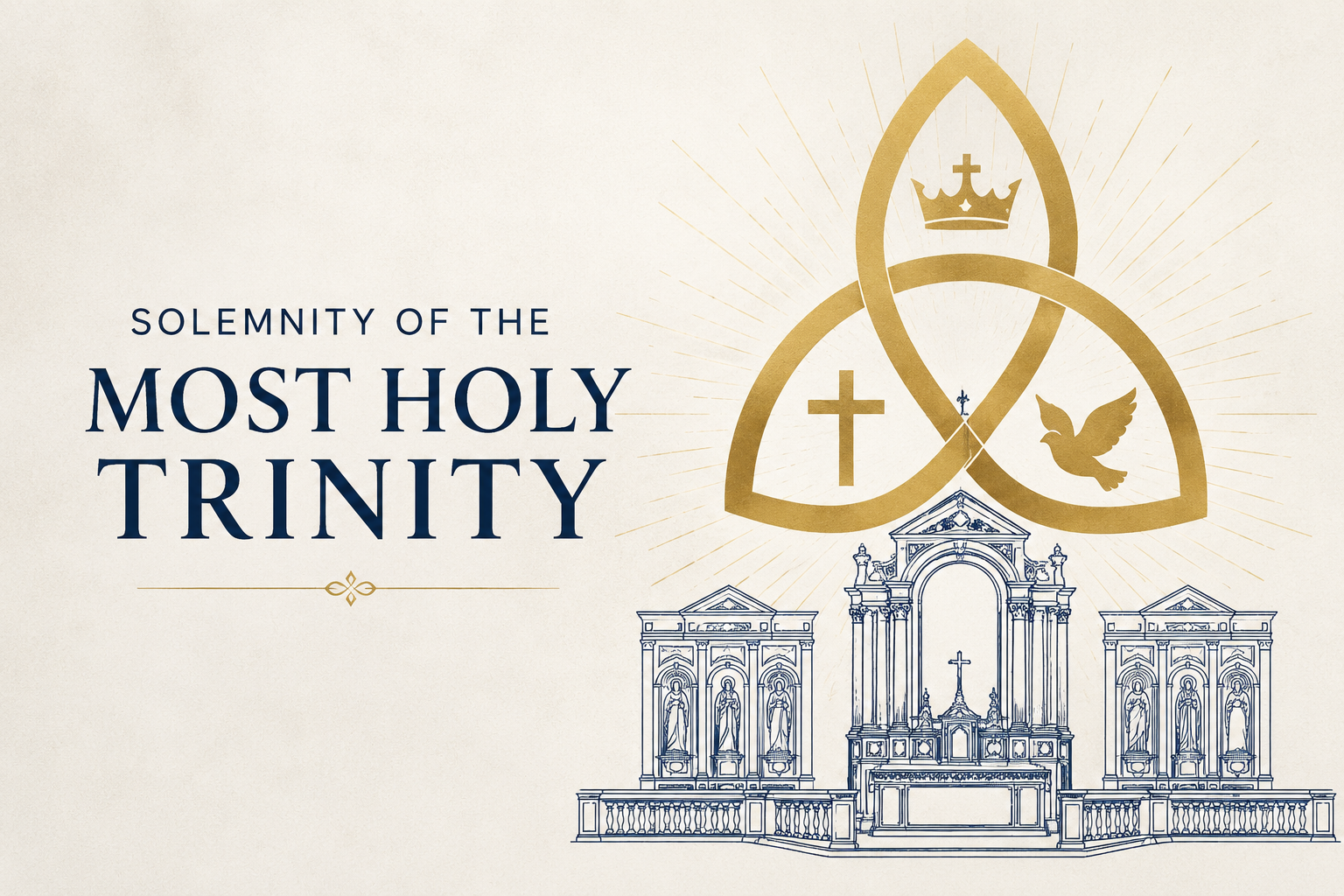
The Solemnity of the Most Holy Trinity
By Johannes
A lay Catholic voice reflecting within the life of the parish
There are some things in life that are not easily explained.
Try explaining to someone from outside Hull why one family can contain supporters of Hull City, Hull FC, and Hull KR, and still manage Christmas dinner without needing a steward in a high-vis jacket. Try explaining why the shared stadium in a Walton Street can feel like a theological problem in itself: black and amber one week, black and white the next, and everyone quite certain that their suffering is the deepest and most authentic.
And then try explaining the Holy Trinity.
One God. Three Persons. Father, Son and Holy Spirit.
At first hearing, it can sound like the sort of mystery best left to theologians, bishops, and people who own more than one volume of the Catechism. But the Solemnity of the Most Holy Trinity is not a puzzle for clever Catholics. It is the heart of Christian life. It tells us not simply what God does, but who God is.
The Vatican reflection on this feast reminds us that Trinity Sunday comes just after Pentecost. Eastertide has ended. The green vestments of Ordinary Time return. But “ordinary” does not mean dull, flat, or spiritually beige. Ordinary Time is where we live the Gospel in the middle of real life: parish life, family life, hospital appointments, school runs, work, grief, forgiveness, and the occasional argument about whether Hull KR or Hull FC are having the better season. The Vatican reflection describes Trinity Sunday as a kind of “synthesis” of the mysteries we have celebrated: Christmas, Easter, the Ascension and Pentecost, all gathered into the truth that God is Father, Son and Holy Spirit.
The Trinity tells us that God is not lonely.
Before anything was made, before the Humber, before the first football chant, before anyone complained about the referee, God was already love. The Father loves the Son. The Son loves the Father. The Holy Spirit is the communion of love. God is not a solitary ruler sitting far away, keeping score. God is living relationship.
That matters.
Because if we are made in the image of God, then we are made for relationship too. Not isolation. Not self-sufficiency. Not “I’m alright, Jack.” We are made for communion — with God and with one another.
Jesus reveals this in his own words. In St John’s Gospel, he says: “Whoever has seen me has seen the Father.” The Vatican reflection draws attention to this: Jesus shows us the Father’s face. He shows us that God is not cold, not distant, not waiting to catch us out, but faithful, merciful and close.
And in the Gospel for Trinity Sunday, Jesus sends his disciples out with a command that every Catholic knows, even if we sometimes forget how astonishing it is:
“Go, therefore, and make disciples of all nations, baptizing them in the name of the Father, and of the Son, and of the holy Spirit.”
— Matthew 28:19
That is why every baptism matters. That is why every Sign of the Cross matters. When we say, “In the name of the Father, and of the Son, and of the Holy Spirit,” we are not simply saying the religious equivalent of “right, let’s begin.” We are placing ourselves inside the life of God.
The Vatican reflection makes a beautiful point about two small words: “in” and “with.” We are baptised in the name of the Father, Son and Holy Spirit; and Jesus promises to be with us. These are not small details. They are the whole Christian life. We live in God, and God walks with us.
And Jesus’ promise still stands:
“And behold, I am with you always, until the end of the age.”
— Matthew 28:20
That is not a vague spiritual slogan. It is the promise of the risen Lord.
Here at St Charles, that promise is lived in very ordinary ways. It is lived when people come to Mass carrying worries nobody else can see. It is lived when someone lights a candle and cannot quite find the words. It is lived in the kindness of parishioners, the welcome given to visitors, the quiet prayers offered for the sick, and yes, even in the deeply Catholic miracle of people managing to organise tea, biscuits and a conversation after Mass without forming a subcommittee. Soon our renovations will be complete. The kettle will be on - and the biscuits will appear.
The Trinity also teaches us how to live with one another. A parish is not a crowd of individuals occupying the same building. It is not meant to be like rival supporters leaving by different exits. We belong to one another because we belong first to God. Father, Son and Holy Spirit reveal a love that gives, receives and shares. That is the pattern of Christian life.
The Vatican reflection says this feast is not for spectators. We are called to “walk with” others and make ourselves neighbours. That is a very practical message. It means patience with the awkward person. Forgiveness when pride wants the last word. A smile to someone new. A phone call to someone missing. A willingness to serve without always needing applause, or credit.
The Trinity is mystery, yes. But mystery does not mean nonsense. It means something so deep that we can enter it, love it, pray it, and live from it, even though we cannot fully contain it.
A God we could completely explain would be too small to worship.
So on Trinity Sunday, we do not solve God like a crossword. We adore him. We trust him. We make the Sign of the Cross. We remember that we are not alone, not forgotten, not spiritually orphaned.
God is Father.
God is Son.
God is Holy Spirit.
God is love, communion, closeness and mercy.
And in the middle of ordinary life — in Hull, at St Charles, among all our joys, muddles, loyalties, rivalries, hopes and prayers — he is still with us.
In the name of the Father, and of the Son, and of the Holy Spirit.
Amen.