When the Wolves
Wear Wool
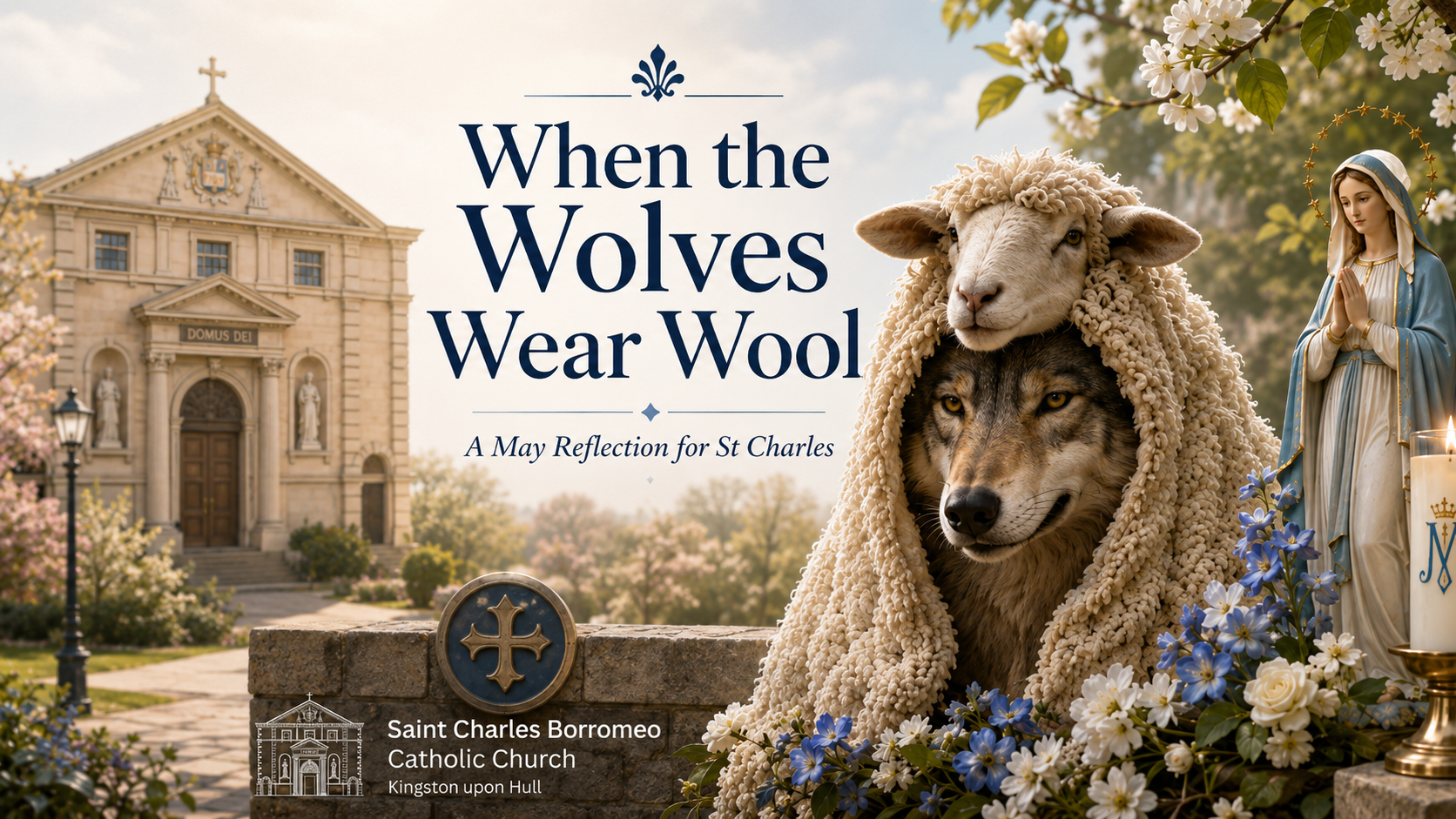
By Johannes
A lay Catholic voice reflecting within the life of the parish
May is a beautiful month in the life of the Church.
The flowers return. The evenings stretch. The church looks a little brighter. The hymns seem to soften. And Catholics everywhere remember Mary, the Mother of the Lord — not as an ornament on the edge of faith, but as the woman who shows us how to listen, how to trust, and how to stand faithfully beside Christ even when the world turns dark. May is Mary’s month.
It is a month of rosaries, candles, flowers, quiet prayers, But the Christian life is never merely decorative. Faith is not a floral arrangement. Mary does not point us towards a soft-focus religion where nothing difficult is ever said. Mary points us to Jesus. And Jesus, loving as he is, is never vague.
He is the Good Shepherd. And if Christ is the Shepherd, then the Church must always be alert to the wolves.
That sounds a strange thing to say in May. Wolves seem more suited to dark forests than to a church full of flowers. But perhaps that is precisely the point. Dangerous voices rarely arrive looking dangerous. We hear them in the news. We hear them on marches, where religion is borrowed like a banner, waved as a sign of identity rather than lived as a path of mercy, humility and truth. They do not usually come snarling through the church door with dramatic music playing in the background.
More often, they arrive sounding quite reasonable.
They speak the language of concern. They talk about protecting the Church. They talk about truth. They talk about tradition. They talk about standards. They reach for the totems of a half-remembered yesteryear, when Britain was said to be “properly British”, as if faith belonged to one flag, one tribe, one culture, or one carefully edited version of the past.
And all those things matter. Of course they do. A Church without truth is just a social club with candles. A Church without tradition is a plant without roots. A Church without standards soon becomes a place where anything can be excused.
But here is the danger: good words can be borrowed by bad spirits. Truth can be spoken without love. Tradition can become pride with incense. Concern can become fear in a sensible hat. And religion can become a very respectable way of avoiding mercy. That is when the wolf begins to wear May flowers.
It does not look fierce. It looks respectable. It looks patriotic. It looks certain. It borrows crosses, flags and holy words, as if religion were there to bless anger rather than convert it. But beneath the wool and flowers there is something that does not sound like Jesus.
That is the test for us at St Charles. Not: does it sound religious? Not: does it sound traditional? Not even: does it sound confident?
The real question is: does it sound like Christ?
When we speak about people outside the Church, does it sound like Christ?
When we speak about the young, the old, the lonely, the divorced, the sick, the poor, the migrant, the awkward, the wounded, the doubtful, the angry, the person who has not been to Mass for years, does it sound like Christ?
When we speak about the Church’s future, do we speak with faith — or merely with fear?
When we speak about decline, change, confusion, politics, society, and the state of the world, do we sound like disciples of the risen Lord, or like people who have forgotten Easter by the middle of May?
That is worth asking. Because May is not just about honouring Mary with flowers. It is about learning her faith.
Mary does not panic. Mary does not posture. Mary does not shout louder than everyone else to prove she is right.
Mary listens. Mary ponders. Mary stays close to Christ. She stands at the Cross when others run away, and she is with the Church as it waits for the Holy Spirit.
And that is what the Church needs in every age: not panic, not slogans, not holy-sounding anger, but hearts that remain close to Christ.
There is a particular danger in our time. We can mistake loudness for courage. We can mistake bitterness for honesty. We can mistake nostalgia for faith. We can mistake being “against” things for being truly Christian.
But Christianity is not simply being against the world. It is being for Christ: for mercy, for truth, for forgiveness, for the lost sheep, for the wounded soul, and for the person who comes to church unsure if they still belong.
For the person who looks at the website only for Mass times and perhaps, without knowing it, is being gently invited back to God.
That matters.
A parish is not just a place where Mass happens. It is a signpost to Christ. The porch, the welcome, the website, the notice sheet, the homily, the handshake, the smile at the back of church — all of these either say “come closer” or “keep your distance”
And in May, Mary quietly asks the Church to say: come closer. Come closer to her Son. Come closer to mercy. Come closer to the Shepherd.
Because the wolf always scatters. The Shepherd gathers.
The wolf feeds on suspicion. The Shepherd feeds his people with himself. The wolf loves division. The Shepherd lays down his life for the flock. The wolf may borrow the words of religion. But the Shepherd speaks with the voice of love.
So in this month of Mary, let us keep watch. Let us keep watch over our own hearts first.
That is always the uncomfortable bit. It is much easier to identify wolves elsewhere. We can spot faults in other people with remarkable spiritual eyesight. We can see the decline of the Church, the failings of society, the mistakes of bishops, priests, parishioners, politicians, neighbours and relatives with astonishing clarity.
But the Gospel always begins closer to home. Is there hardness in me? Is there fear in me? Is there pride in me? Have I used truth without tenderness? Have I used faith as a defence against love? Have I become more interested in being right than being holy?
These are May questions too.
Not gloomy questions. Honest questions. Easter questions. Questions asked in the light of the risen Christ.
Because the Church is not saved by pretending there are no wolves. The Church is saved by staying close to the Shepherd.
And Mary, Mother of the Church, always leads us there. Not to herself alone. Not to sentiment. Not to religious decoration.
But to Jesus.
“Do whatever he tells you,” she says. And what does he tell us?
Love one another. Forgive. Feed my sheep. Do not be afraid.
Go out. Make disciples. Receive the Holy Spirit.
So let May be beautiful, yes.
Let there be flowers. Let there be candles. Let there be hymns to Our Lady. Let there be rosaries and quiet prayers. Let there even be patient conversations about parish change, and about the opportunities it may bring.
The courage to recognise the wolf, even when it wears wool. The courage to reject cruelty, even when it sounds clever. The courage to speak truth with love. The courage to make St Charles not merely a church with a fine building, but a living doorway to Christ.
Because the world has enough anger. It has enough noise. It has enough people shouting in the name of certainty.
What it needs is the voice of the Shepherd.
And in May, under Mary’s quiet gaze, may that voice be heard again — in our worship, in our welcome, in our words, and in the life of this parish.