Season of Creation
By Johannes
A lay Catholic voice reflecting within the life of the parish
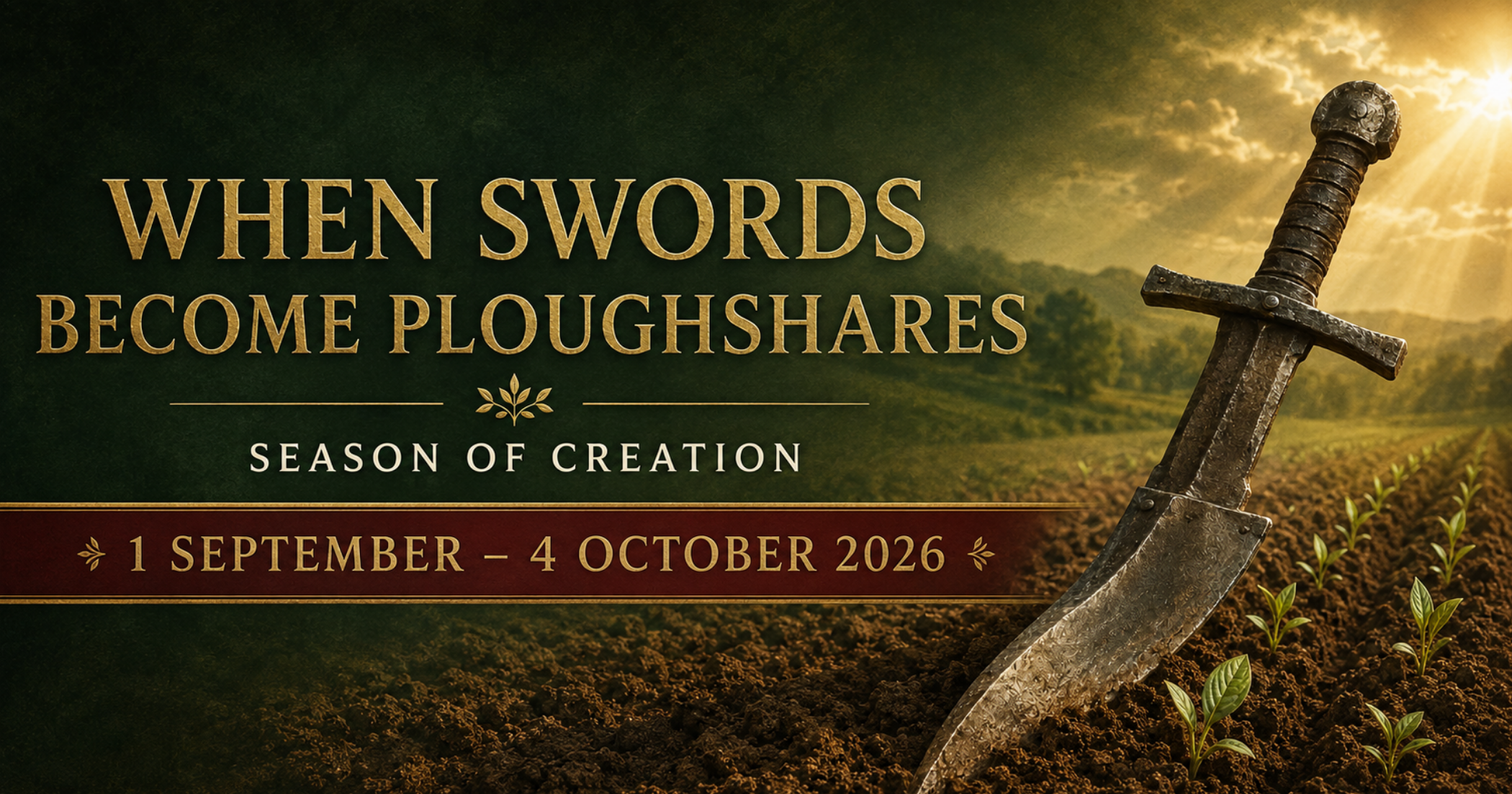
The Season of Creation begins on 1 September. Pope Leo XIV has chosen Isaiah’s vision of swords becoming ploughshares, which sounds rather grand until we discover that the sword in question may be sitting quietly inside ourselves.
There comes a moment in the life of every British garden shed when an innocent person reaches for a trowel and is attacked by two rakes, a folding chair and something bought from B&Q in 1998 for a purpose nobody can now remember. There may be a ploughshare beneath it all. There is probably not a sword.
Isaiah knew about both. He looked towards a time when nations would “beat their swords into ploughshares and their spears into pruning hooks” (Isaiah 2:4). It is one of those biblical phrases which has become so familiar that we can admire it without allowing it to interfere with us. Pope Leo XIV has brought it back into the light. He has chosen Isaiah’s words for the 2026 World Day of Prayer for the Care of Creation, which is observed on 1 September and begins the Season of Creation. The season continues until 4 October, the feast of St Francis of Assisi.
At first sight, swords may seem an odd choice. We might have expected a tree, a river or possibly a photograph of a polar bear looking reproachfully at the camera. The Season of Creation is easily filed in the mind alongside recycling arrangements, reusable shopping bags and remembering which day of the week the brown bin goes out. Pope Leo has something deeper in mind. A sword and a ploughshare can be made from the same metal. One tears open a human body. The other opens the earth so that seed can be planted. One brings death; the other prepares for a harvest. The metal has not been thrown away. It has been converted. That is the heart of the Pope’s message.
War does not injure human beings while politely leaving the rest of creation alone. It burns crops, poisons water, destroys homes and leaves farmland seeded with mines. It scatters families and ruins the ordinary means by which they once fed themselves. Even when the soldiers have departed and the television cameras have found another tragedy, the soil remembers.
War is creation running backwards. In Genesis, God brings order from chaos. Light appears. Waters are separated. The earth produces plants and living creatures. At last, humanity is placed within the garden, not as its owner but as its keeper. War takes homes and returns them to dust. It turns gardens into craters and clean water into poison. It takes the neighbour, made in the image of God, and reduces him to a target.
The Pope’s choice of Isaiah is therefore not an excursion away from care for creation. It takes us to the centre of it. We cannot love the earth while being indifferent to the people who live upon it. Nor can we claim to care about human beings while poisoning the water they drink and destroying the soil from which their food must grow. The cry of the earth and the cry of the poor are not two competing noises. Listen carefully and they belong to the same wounded world. Yet Pope Leo does not allow us to leave the problem safely in the hands of governments, generals and people attending international conferences in rooms with an alarming number of flags. The trouble begins closer to home.
Before there is a battlefield, there is usually a human heart in which another person has ceased to be a neighbour. Greed, pride and the desire to dominate do not arrive wearing military uniforms. They begin quietly. They may first appear as resentment, contempt, indifference or the conviction that my comfort matters more than somebody else’s life. Most of us do not possess a sword, but we know how to keep an edge on a grievance. We know the cutting remark which could be deployed at precisely the right moment. We know how to win an argument and lose a friend. We know how easily another person can become a nuisance, a category or a problem to be moved elsewhere. The battlefield and the polluted river have something in common. Both reveal what happens when human power is separated from love. This is why the Christian response to the suffering of creation must involve more than changing our shopping habits, worthwhile though that may be. Pope Leo calls for a conversion of heart.
Conversion is an uncomfortable word. It suggests that the problem may not be entirely somebody else’s fault. It also suggests hope. A sword can be changed. The fire and hammer do not destroy the metal; they release it from its old purpose. What was fashioned to wound can be remade to cultivate. The Church does not worship nature. We worship the God who created heaven and earth and who entered his creation in Jesus Christ. The Word became flesh, not an interesting idea.
Our faith is gloriously material. Water is poured at Baptism. Oil is used in Confirmation and the Anointing of the Sick. At Mass, the earth itself comes to the altar in the form of bread and wine, joined to human labour and offered back to God. Christ does not despise matter. He takes it, blesses it and makes it a place of encounter. That should make it difficult for Christians to treat creation as a heap of disposable material left for our convenience. The earth is not God, but it is God’s. We are guests who have been trusted with the keys, although our record with the furniture has not always been encouraging.
Here in Hull, we live beneath a sky which is rarely short of opinions and beside a river whose tides continue without consulting the council. The wind can overturn an umbrella, rearrange a hairstyle and correct an inflated sense of human importance in about three seconds. Creation has a way of reminding us that we are creatures too.
The Season of Creation is not a competition to discover who can acquire the greenest halo. Nobody is excluded because they once put a yoghurt pot in the wrong bin. It is a time to recover gratitude. Gratitude changes the way we handle things. Food received as a gift is less easily wasted. A neighbour recognised as a brother or sister is less easily ignored. A world received from God is less easily treated as our private possession.
The changes may be small: wasting less, mending something, tending a neglected patch of ground, sharing what we possess or simply paying attention to people whose lives are being damaged by conflict, flooding, drought or pollution. Small does not mean pointless. The Kingdom of God has always had a suspicious fondness for seeds.
There is also the harder work: allowing Christ to take the swords within us. The old anger. The appetite that must always be satisfied. The need to have the final word. The indifference which protects us from the inconvenience of another person’s pain.
God does not merely confiscate these things and leave an empty space. Grace reshapes them. Anger can become courage. Restlessness can become service. Possession can become generosity. Sorrow can become compassion. The metal remains, but it receives a new purpose.
Perhaps that is the question Pope Leo’s message leaves with us. Not simply, “What should the world do?” but, “What am I willing to place upon God’s anvil?” Somewhere beneath the clutter of the human heart, there may be a sword waiting to become useful.
And God, unlike the rest of us, never forgets where he put the hammer.