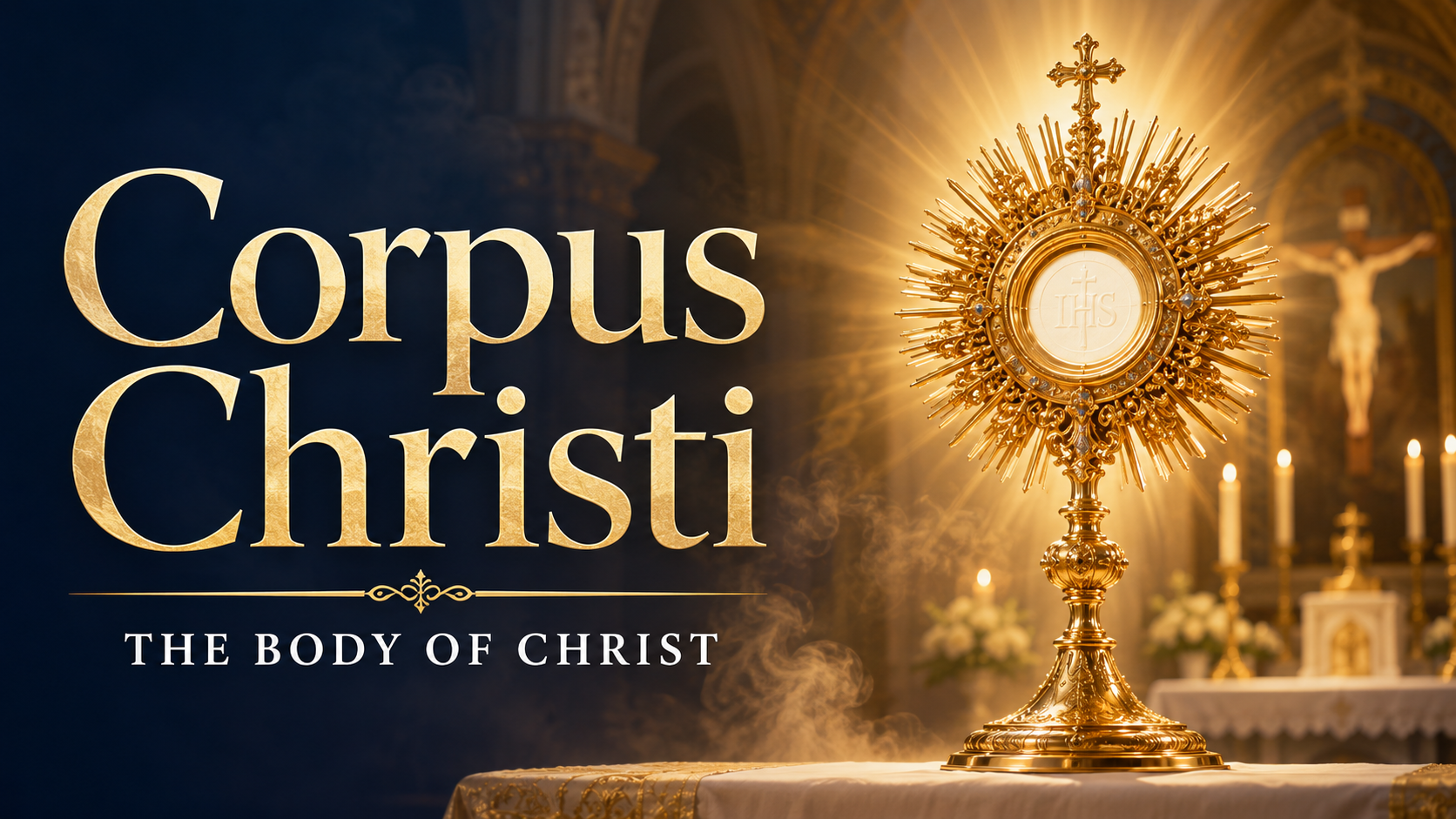
Corpus Christi
On this great feast, the Church asks us to look again at the Eucharist — not as a symbol to admire, but as Christ Himself, given for the life of the world.
By Johannes
A lay Catholic voice reflecting within the life of the parish
Corpus Christi is one of those feasts where the Church subtly removes all the escape routes — rather like trying to get out of Hull Fair without buying brandy snap, chips, and something flashing that no sensible adult should own.
There are Sundays when we can stay at a safe distance. We can think about kindness, justice, forgiveness, prayer, being generally better human beings, and not reversing into someone’s car after Mass in Jarratt Street — which is remarkably difficult to do anyway, given the unusually generous spaces. Could those two-for-the-price-of-one parking spaces have been the result of Patrick’s influence when he was on the council?
All very good.
But Corpus Christi does not let us remain in the comfortable outer suburbs of religion. It brings us right to the altar.
Not to an idea. Not to a memory. Not to a religious mood. Not to a nice shared meal with candles and decent intentions.
To Christ. Body, Blood, Soul and Divinity. That is the Catholic claim. Not a decorative opinion. Not a sentimental flourish. Not the sort of thing we whisper apologetically in case someone educated overhears us. The Church teaches that in the Eucharist, Jesus Christ is truly present. Really present. Substantially present.
Now, to the hard materialist, this may sound like religious mumbo-jumbo. Bread is bread. Wine is wine. Matter is matter. The universe is particles, forces, chemistry, and biology.
But the Christian does not look at matter as dead stuff in a godless machine. We look at creation and see something deeper: order, meaning, beauty, consciousness, love, sacrifice, and a universe that seems to ask questions bigger than a laboratory can finally answer. Science can explain processes. It can tell us a great deal about how things happen. And thank God for it. But science does not remove God. It may even, for those with eyes to see, deepen the mystery. It can show us the machinery of creation, but it cannot finally tell us why there is creation at all.
Faith is not the enemy of reason. Faith is not a refusal to think. Faith is reason opening the window and admitting that reality may be larger than what can be weighed, measured, photographed, or put into a spreadsheet.
So yes, to some, the Eucharist will sound impossible. To the strict materialist, it may sound like pious nonsense dressed up in gold and incense. But to others, there is faith. And to some very serious scientists and philosophers, there are powerful signs that the universe is not an accident without meaning, but a creation marked by order, intelligence and purpose.
And while the full truth may be beyond the complete grasp of any one of us — believer or sceptic — the signposts are there. For the faithful, they point towards the promised road: the road of Christ, the road of grace, the road that leads not merely to explanation, but to salvation.
The presence of Christ in the Eucharist is either the most astonishing truth in the world — or Catholics have been forming orderly queues for two thousand years for a very small piece of bread and a serious misunderstanding.
There is no middle ground.
You cannot put a metaphor in a monstrance.
You cannot genuflect to a memory.
You cannot build cathedrals, tabernacles, processions, Benediction, First Holy Communion dresses, incense, bells, hymns, silence, sacrifice, saints and martyrs around “a helpful symbol”.
If it is only bread, then frankly, we are seriously overdoing it.
But if it is Christ — if it is truly Him — then we are not doing nearly enough.
That is Corpus Christi. The Church standing up in the middle of a distracted world and saying:
Here He is. Not hidden behind power. Not protected by distance. Not locked away in heaven like someone avoiding their emails.
Here. Under the appearance of bread.
Small enough to be ignored. Quiet enough to be overlooked. Humble enough to be received by children, pensioners, sinners, doubters, nurses, builders, widows, students, the anxious, the weary, the holy, the not-so-holy, and the person who came in late and is hoping nobody noticed.
This is the scandal of the Eucharist.
God comes to us in a form so ordinary that we can miss Him. We might have expected thunder. We might have expected lightning. We might have expected something dramatic enough to make the BBC break into Bargain Hunt.
But God gives Himself as food. Not as a theory. Not as a slogan. Not as a motivational poster with a sunset and a questionable font.
Food.
Because we are not brains on sticks. We are not spiritual vapour floating about trying to be pleasant. We are flesh and blood. We hunger. We weaken. We get tired. We fail. We need feeding. And Christ knows it.
At the Last Supper, Jesus did not say, “Think about me occasionally.” He did not say, “Form a committee in my memory.” He did not say, “Here is a concept.”
He said:
This is my Body.
This is my Blood.
Do this in memory of me.
And the Church, from the apostles to the present day, has taken Him at His word.
The Vatican’s teaching is clear. The Eucharist is the “source and summit” of the Christian life. That means it is not an optional extra. It is not Catholic decoration. It is not the spiritual equivalent of parsley on the plate.
It is the heart. Everything flows from it. Everything leads back to it.
The parish, the school, the charity, the prayer group, the sick visit, the funeral, the baptism, the confession, the candle lit by someone who has run out of words — all of it finds its centre here. At the altar.
And that matters for St Charles. Because a parish is not held together merely by rotas, newsletters, Facebook groups, or good intentions. A parish is held together by Christ. We gather because He gathers us. We pray because He draws us. We serve because He feeds us. We endure because He remains with us.
The tabernacle is not holy storage. It is the burning heart of the church. That little red sanctuary lamp is not mood lighting. It is not there to improve the ambience. It is saying something that should stop us in our tracks:
He is here.
When the church is full, He is here. When the church is nearly empty, He is here. When the choir is glorious, He is here.
When the responses may sometimes limp along like a shopping trolley with a dodgy wheel, He is here. When our faith is strong, He is here. When our faith is hanging by a thread, He is here.
And that changes everything.
Because if Christ is truly present in the Eucharist, then Mass is not something we watch. Mass is not a performance by the priest, with the congregation acting as a mildly responsive audience. Mass is sacrifice. Mass is worship. Mass is Calvary made present. Mass is heaven touching earth.
We do not come to Mass simply to “get something out of it”, as though the Eucharist were a spiritual vending machine and we are entitled to a decent return for our parking effort. We come because He is worthy. We come because He has loved us first. We come because He gives Himself. We come because without Him we become thin, brittle, noisy and lost.
Holy Communion is not a reward for having been without sin. Thank God for that, because the queue would be short. Holy Communion is Christ giving Himself to sinners so that sinners may become saints. Not perfect people. Not polished people. Not people who have finally got themselves sorted and can present the Almighty with a tidy spiritual CV.
Sinners - Hungry people. Wounded people. People who know that left to themselves, they drift.
That is why we must receive the Eucharist with reverence. Not fear. Not scruple. Not panic. But reverence. Because this is not ordinary food. We do not shuffle up casually as if collecting a biscuit at an office meeting. We come with open hands, open hearts, and a holy seriousness.
We say “Amen”. And that Amen is not a mumble. It is not a password. It is not a small Catholic noise made before moving to the side.
It means: Yes, I believe. Yes, Lord, I receive You. Yes, I need You. Yes, change me. And that is the point.
We cannot receive the Body of Christ and then despise the Body of Christ in one another. We cannot kneel before the Host and then spend the week tearing people to pieces with our tongues. We cannot say “Amen” to Christ at the altar and “absolutely not” to Christ in the poor, the lonely, the difficult, the irritating, the inconvenient, or the person at the back who never seems to sing the same line as everyone else.
The Eucharist makes demands. It asks us to become what we receive. If we receive Christ’s Body, then we must become His Body in the world.
That is not vague religious poetry. It is the Christian life.
Feed the hungry, forgive the enemy, visit the sick, comfort the grieving, welcome the stranger. protect the weak, speak the truth, carry the Cross, and love when love is costly.
Corpus Christi is not a feast of private piety alone. It is a public declaration that Christ is the life of the world.
That is why Eucharistic processions matter. We do not carry the Blessed Sacrament through the streets because God needs fresh air. We do it because the world needs to know He has not abandoned it.
Christ belongs not only inside church walls, but in the streets, homes, hospitals, schools, care homes, tower blocks, terraces, bus stops, shopping centres and quiet rooms where people are frightened and nobody knows.
He is Lord there too. Not aggressively, not arrogantly, not with banners that say, “We are better than you.”
But humbly, beautifully, truthfully. The Host is small. The claim is enormous.
This is Jesus Christ.
The same Lord who healed the sick. The same Lord who forgave sinners. The same Lord who wept at Lazarus’s tomb. The same Lord who was nailed to the Cross. The same Lord who rose from the dead. The same Lord who will come again in glory.
And today He comes to us under the appearance of bread.
So on Corpus Christi, let us not be casual. Let us not reduce the Eucharist to habit. Let us not allow familiarity to become blindness.
At St Charles, let us look again at the altar, the tabernacle, the sanctuary lamp, the Host lifted before us, and allow the truth to land with its full weight:
God is here. God gives Himself. God feeds His people.
And perhaps the most astonishing thing is not that bread becomes Christ. Or maybe more astonishing, that Christ is willing to come to us at all. To our distracted minds. To our compromised hearts. To our tired parish life. To our unfinished holiness. To our ordinary Sunday morning.
He comes anyway.
That is love. That is the Eucharist. That is Corpus Christi. So come hungry. Come reverently. Come honestly. Come with faith, even if that faith is only the size of a crumb.
Because the Lord who gives Himself under the appearance of bread is not small. He is infinite love made close enough to receive.
And when the priest says, “The Body of Christ,” let your Amen mean it. Not a polite Amen. Not a sleepy Amen. Not an Amen that is already thinking about Sunday dinner.
A real Amen.
The kind that says: Lord, I believe. Lord, I need You. Lord, feed me. Lord, change me. Lord, make me Yours.
Amen.