
Parish News Archive July 2026
This page brings together the main parish news and announcements from July 2026. It offers a record of parish life at this moment in time — preserving events, stories and memories for future historians, while also providing parishioners with an opportunity to look back on recent months.
JULY 2026 NEWS ITEMS
APPEAL FOR VOLUNTEERS:
In anticipation of the enhanced service frequencies later in September 2026 and as a means of facilitating increased opening times, Fr Phil has appealed for volunteers to help support the changes. If any parishioner is interested, please contact Fr Phil using the website contact form - or speak to him after Mass.
Pilgrimage for the Assumption:
On Sunday 16th August 2026 there will be a pilgrimage to the Diocesan Shrine of Mount Grace at Osmotherley in North Yorkshire. Mass will take place at the Lady Chapel with Bishop Marcus. Details of a coach leaving from Cottingham Rd to follow.
100 Club:
WInning numbers are published in our Newsletter. There are still vacancies if you would like to join the 100 Club draw. Please contact Fr Phil to come on board.
PARISH CHANGES UPDATE
Fr Charles Bassey has become Parish Priest at the South Holderness churches in Hedon, Withernsea and Hornsea with effect from Monday 13 July 2026. We welcome him to the area and wish him well as he begins his new ministry . He can be contacted by email: holdernesscatholic@rcdmidd.org.uk or by telephone on 01482 898338
Fr Phil Cunnah is now focused on his ministry at Saint Charles Borromeo, including the key task of overseeing the restoration of our Grade I listed building and the development of the parish - as we approach the bicentenary in 2029
FR Phil can be contacted by email: saintcharleshull@rcdmidd.org.uk A new telephone contact number will be published shortly, but in the meantime, please use 01482 898338.
Grant application:
We have now learnt that a grant application to Historic England for various repairs and works in the church has been deferred to later in the year. This isn’t a rejection so we still have hope that our expression of interest will be considered in due course.
SVP at Saint Charles Borromeo
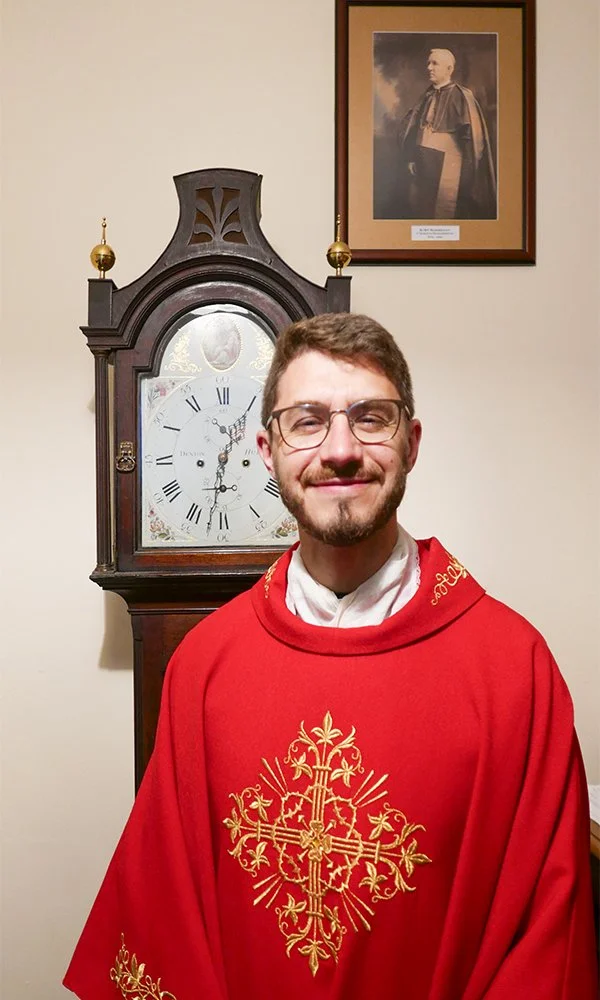
Saturday 25th July marked the eleventh anniversary of Fr Phil’s ordination to the priesthood. His homily at the lunchtime Mass touched upon words of St Paul which speak with particular force about the Christian life and ministry.
Writing to the Corinthians, Paul describes a life that is anything but comfortable. There are hardships, uncertainty and opposition. He speaks of being pursued and knocked down, but not destroyed..
“We are subjected to every kind of hardship, but never distressed; we see no way out but we never despair; we are pursued but never cut off; knocked down, but still have some life in us.”
2 Corinthians 4:8–9
There is something wonderfully realistic about St Paul. He does not pretend that following Christ makes the road smooth. Priests know that as much as anyone. Their ministry takes them into the happiest moments of people’s lives and some of the darkest: baptisms and weddings, hospital beds and funerals, celebrations and disappointments. There are days of great encouragement and others when simply carrying on is an act of faith.
Yet Paul’s confidence does not rest upon his own strength. Just before these words he describes Christians as “earthenware jars” carrying a treasure far greater than themselves. The vessel may be fragile; the treasure is Christ.
That is perhaps a fitting thought on an anniversary of ordination. Priesthood is not a story of human perfection or invulnerability. It is a vocation lived, like every Christian vocation, through ordinary human weakness, sustained by the grace of God.
Eleven years after his ordination, we give thanks for Fr Phil’s priestly ministry and for all those years of Masses offered, people welcomed, sacraments celebrated, prayers said and lives accompanied.
St Paul knew what it was to be knocked down. He also knew why he could get up again.
At the heart of his hope was the conviction that the God who raised Jesus from the dead would not abandon those who placed their trust in him.
Ad multos annos, Fr Phil.
May God grant you many more fruitful years of priestly ministry
Ann Widdecombe:
Faith, Public Service and Her Friendship with Hull
News Obituary: July 2026
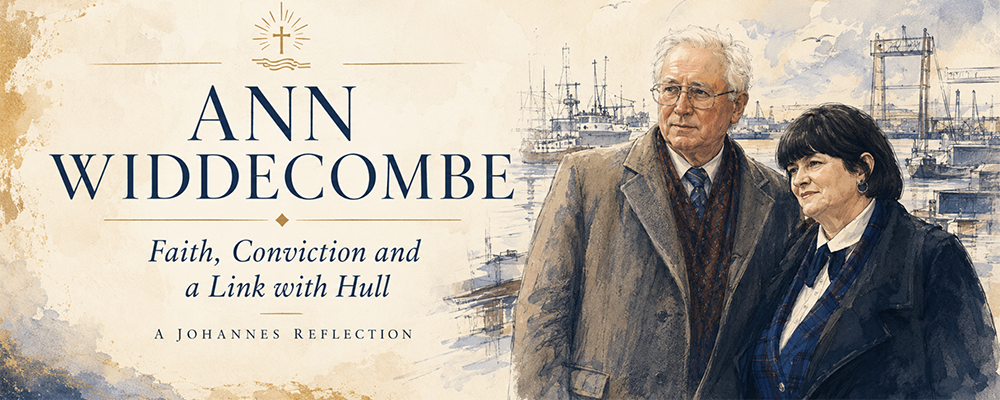
The death of Ann Widdecombe has brought tributes from people across the political divide. That seems fitting. She was never a politician who slipped quietly through a room, careful not to disturb the furniture. She spoke plainly, argued vigorously and was quite prepared to stand alone. People might disagree with her — sometimes profoundly — but very few were left wondering what she believed.
For Catholics, however, there was another side to Ann Widdecombe’s public life. Her politics and her faith were not separate compartments, brought out according to the occasion. She became a Catholic in 1993, after years of reflection and dissatisfaction with the direction of the Church of England. Whatever judgement people made about her political conclusions, nobody could reasonably doubt that her Christian convictions were serious.
She defended the dignity of human life, opposed abortion and assisted dying, and spoke openly about the importance of religious belief in public life. In 2013 Pope Benedict XVI appointed her a Dame of the Order of St Gregory the Great, recognising her service to politics and public life. She was also sometimes a reader at the Sunday evening Mass in Westminster Cathedral. The formidable television personality, the sharp parliamentary debater and the familiar figure from Strictly Come Dancing was also a woman who stood at the lectern and proclaimed the Word of God.
Hull had its own connection with her. During the mid-1990s she served for about three years as the Government’s designated Minister for Hull. It was not the same as being one of the city’s MPs, but it gave her a particular government responsibility for Hull at a time when the city faced serious economic and social challenges. Although Hull’s civic leadership was largely Labour, she gained respect from political opponents who recognised her commitment to the role. In a city not known for being easily impressed by visiting politicians, that was no small achievement.
Patrick Doyle, a Saint Charles parishioner who was then leader of Hull City Council and Chair of the partnership City VIsion, remembers attending a conference in Liverpool called by the Bishops of England and Wales for Catholics of all political parties who were public representatives. His colleague, Councillor Des Montgomery, another member of the congregation at St Charles, was also there.
By then Patrick knew Ann well, and she joined the Hull table for meals. Their politics were different, but their faith was the same. That connection says something valuable in an age when political disagreement too easily becomes personal hostility. Catholics have never all belonged to one political party, nor should they. The Church is not a party headquarters with a crucifix over the door. Catholic social teaching challenges every political tradition: the right on poverty and solidarity, the left on the sanctity of life and the family, and all of us on the dignity of those we find inconvenient.
What Catholics can share, even amid strong disagreement, is the recognition that public life ought to be a form of service. Politics matters because people matter: the child not yet born, the prisoner, the unemployed worker, the elderly person fearful of becoming a burden, and the family struggling to keep its head above water. Ann Widdecombe’s answers were not everyone’s answers, but she did not treat such questions as mere lines in a briefing paper. She believed that moral choices were real and that politicians would one day answer for them.
There was humour too. Her years after Westminster revealed a willingness to be laughed at and, more importantly, to laugh at herself. Her partnership with Anton Du Beke on Strictly was unlikely, frequently chaotic and strangely endearing. She once observed that life was not a dress rehearsal and that we get only “one go this side of eternity”. Behind the joke was a thoroughly Christian understanding: earthly life is precious, purposeful and brief.
The shocking violence of her death must not be allowed the final word. For Christians, death never has the final word. Our response is not simply to praise a public career, but to pray for a soul: to commend Ann Widdecombe to the mercy of God, to pray for those who mourn her, and to ask that hatred may not poison our public life.
Ann was forceful, sometimes controversial, often funny and unmistakably herself. Patrick’s memory of meeting her across political differences offers a fitting image: two Catholics in public life, not necessarily voting alike, but standing on common ground before God.
May she rest in peace.
by Johannes. July 2026