Saints Peter and Paul
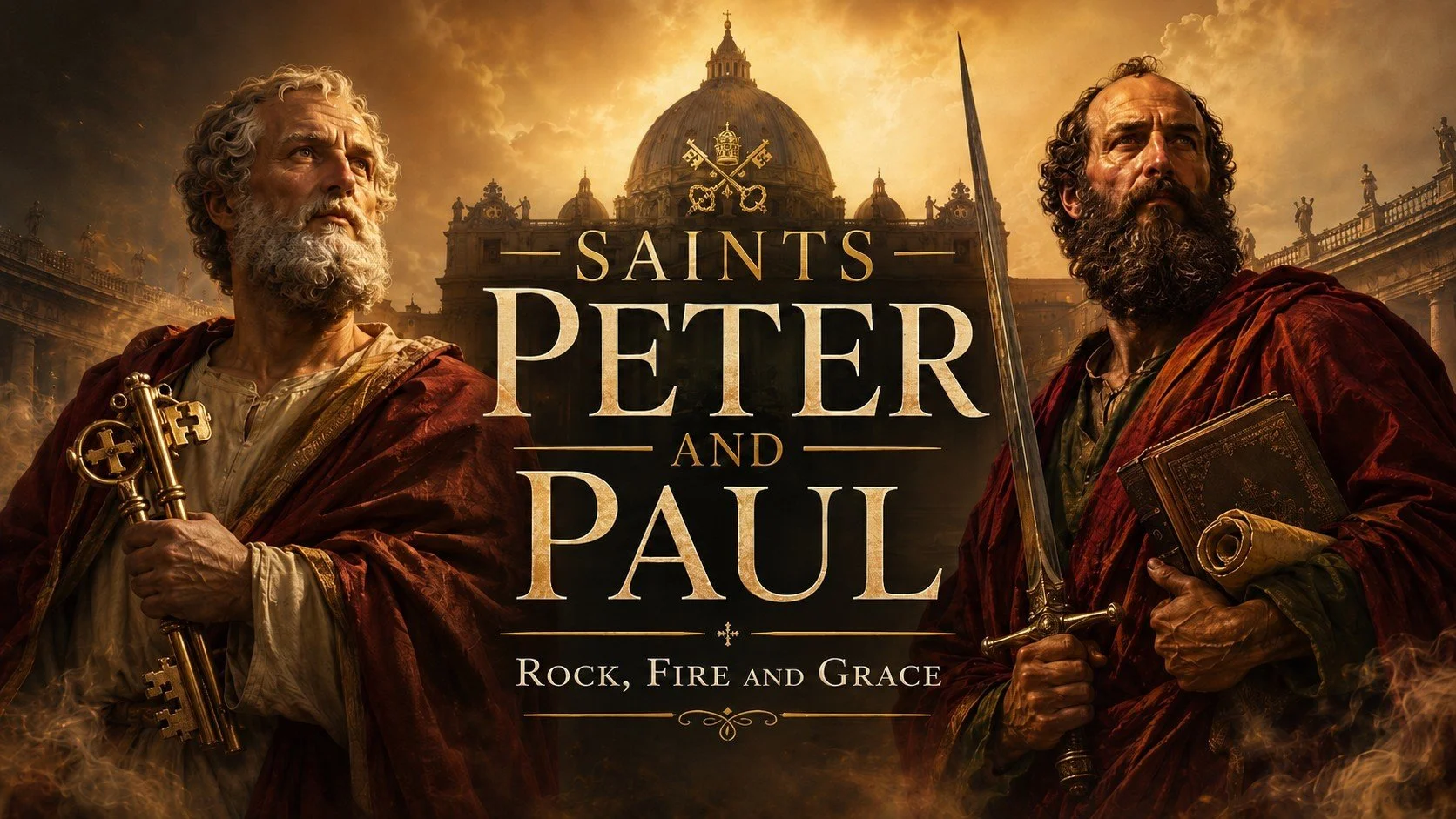
By Johannes
A lay Catholic voice reflecting within the life of the parish
There are some feasts you can almost miss if you are not careful. A quiet saint here. A bishop there. Someone holy from the fourth century with a beard, a staff, and a name that sounds like a minor road off Beverley Road.
But Saints Peter and Paul are not background saints.
They are not ecclesiastical soft furnishings. They are not the holy equivalent of those mysterious parish cupboard items nobody dares throw away because “they might be needed one day”. Peter and Paul are giants.
Not because they were flawless. Not because they were polished. Not because they arrived fully trained, laminated, risk-assessed and ready for parish ministry. Quite the opposite.
Peter was impulsive, brave, frightened, loyal, weak, loud, generous, confused, magnificent and occasionally a walking pastoral incident. Paul was brilliant, intense, fearless, argumentative, learned, relentless and, before his conversion, spectacularly on the wrong side of the story. If you were setting up the Church from scratch, you might not immediately pick either of them.
Peter would probably speak before the microphone was switched on, promise everything before coffee, and then realise he had misunderstood the rota. Paul would write a twenty-seven-page email correcting everyone’s theology, copy in half the Roman Empire, and still somehow be right. And yet these are the men Christ chose.
Peter, the fisherman. Paul, the persecutor turned apostle. One denied Christ. The other hunted Christians. And God looked at them both and said, in effect: “Yes. I can work with that.” Which is a relief for the rest of us.
Because the feast of Saints Peter and Paul is not a celebration of human perfection. It is a celebration of divine grace. It tells us that the Church is not built because human beings are impressive. The Church is built because Christ is faithful.
Peter matters because Christ chose him as the rock. “You are Peter, and on this rock I will build my Church.” That is not a small sentence. It is not Our Lord handing out a friendly nickname after a successful fishing trip. It is a calling. A commission. A terrifying responsibility.
Peter is given the keys. Peter is told to strengthen his brethren. Peter is told to feed Christ’s sheep. And yet Peter is also the man who sinks when he tries to walk on water. The man who misunderstands. The man who says he will die with Jesus and then, by a charcoal fire, insists he does not even know Him. That is Peter. Rock and rubble in the same man.
And if that sounds strange, look honestly at the Church. Look honestly at any parish. Look honestly at ourselves. Faith and fear. Courage and collapse. Love and cowardice. Big promises and small follow-through.
Peter is not comforting because he was perfect. Peter is comforting because he failed and was restored. After the Resurrection, Jesus does not cancel Peter. He does not say, “Well, that was disappointing. We’ll be recruiting again after Easter.”
He asks him three times: “Do you love me?” Not: “Can you explain everything?” Not: “Have you produced a strategic plan?” Not: “Can you guarantee no further nonsense?” “Do you love me?” And Peter, wounded by mercy, says yes. Then Jesus gives him work to do. “Feed my sheep.”
That is the Catholic Church. Not a society of the spiritually smug, but a people gathered around Christ, forgiven by Christ, and sent out by Christ — with Peter given a particular ministry of unity and strengthening.
Then there is Paul. Paul does not slip quietly into the story. Paul arrives like a thunderstorm with paperwork. He is first seen approving the killing of Stephen, the first martyr. He is zealous, educated, certain, dangerous. He believes he is defending God while persecuting the followers of God’s Son. Then comes the road to Damascus. A blinding light. A voice from heaven. A man knocked to the ground by the truth. “Saul, Saul, why are you persecuting me?” Not “my followers”. Not “my organisation”. Not “my religious movement”. “Me.”
There is the mystery of the Church in one sentence. Christ is so united with His people that to wound them is to wound Him. Paul never got over that. And thank God he didn’t. He spent the rest of his life preaching the Christ he once opposed. Shipwrecked, beaten, imprisoned, misunderstood, exhausted, opposed — and still pressing on. Paul had discovered that Christianity is not a little improvement plan for respectable people.
It is death and resurrection. it is grace. It is Christ living in us.
Paul gives the Church words that still burn after two thousand years:
“God’s love has been poured into our hearts.” “I am alive, no longer I but Christ lives in me.”
“Nothing can separate us from the love of God in Christ Jesus our Lord.”
These are not fridge-magnet slogans. They are battle-tested truths from a man who paid for them in suffering. Peter gives us the rock. Paul gives us the road. Peter anchors the Church in apostolic faith and visible unity. Paul drives the Gospel out to the nations. Peter reminds us that the Church must be one. Paul reminds us that the Church must be missionary. Peter says: remain in the faith handed down. Paul says: take that faith to the ends of the earth.
And both of them end in Rome. Not on a career high. Not with comfortable retirement plans and a modest testimonial dinner. With martyrdom. Peter, according to ancient tradition, was crucified. Paul, the Roman citizen, was beheaded. Rome is not merely an administrative centre of the Church. It is a place of apostolic witness, marked forever by Peter and Paul. The Church of Rome carries their memory not as historical decoration, but as a living responsibility.
That is why Catholics care about apostolic faith. That is why unity matters. That is why the Pope matters — not because every pope is personally dazzling, but because Christ gave His Church a visible centre of unity in Peter and his successors. Peter’s office remains because the Church still needs strengthening. And Paul’s fire remains because the world still needs evangelising.
Which brings us to St Charles.
A parish is not meant to be a cosy religious museum with heating problems. It is not a Sunday heritage society for people who know when to stand, sit, kneel and glance discreetly at the bulletin. A parish stands in the line of Peter and Paul. Peter says to us: keep the faith. Paul says to us: share it. Peter says: know who you are. Paul says: do not keep it to yourself. That is a timely message, because it is very easy for Catholic life to become timid. We can grow apologetic about the very things that give life. We can whisper the Creed as though it were mildly embarrassing. We can treat the Gospel as though it needs wrapping in bubble wrap before being allowed out in public.
But Peter and Paul did not die for a vague spirituality. They did not suffer for a polite moral atmosphere. They did not give their lives so that we might occasionally feel uplifted, avoid serious inconvenience, and keep religion safely between ourselves and the hymn board.
They died for Christ. Christ crucified. Christ risen. Christ present in His Church. Christ given in the Eucharist. Christ calling sinners to repentance. Christ sending His people to the world. That is the faith of Peter and Paul. Not soft. Not fashionable. Not always easy. But true.
And here is the left-field comfort of this feast: God builds with unlikely materials. He built with Peter, who denied Him. He built with Paul, who persecuted Him. He built with frightened apostles, squabbling communities, exhausted missionaries, repentant sinners, widows, prisoners, martyrs, teachers, bishops, children and saints nobody noticed. So He can build with us. He can build with St Charles. He can build with people who are tired, distracted, bruised, uncertain, late, imperfect and occasionally wondering whether they have enough faith to get through the week.
He does not ask us to be Peter and Paul at their most heroic by teatime. He asks us to begin.
To love Christ. To return when we fall. To hold the faith. To speak the truth. To pray. To serve. To keep going.
Peter fell and was raised. Paul was wrong and was converted. Both became saints. That is not merely their story. It is the Church’s story. It can be ours too. Saint Peter, strengthen our faith. Saint Paul, set our hearts on fire. Saints Peter and Paul, pray for us.