Solemnity of the Assumption of the Blessed Virgin Mary
16 August
By Johannes
A lay Catholic voice reflecting within the life of the parish
The Assumption: The Promise Already Fulfilled
The Solemnity of the Assumption of the Blessed Virgin Mary — Sunday 16 August 2026
On Friday evening, millions of mobile phones across England and Wales suddenly sounded an alarm. For once, even those who can never remember where they left their phone knew exactly where it was. The Government’s emergency alert warned of a very high risk of wildfires. After months with scarcely any rain, the ground is parched, lawns have turned brown and the countryside has become dangerously combustible. One carelessly discarded cigarette or ill-advised barbecue could be enough to cause devastation. Into this dry and anxious summer comes the Solemnity of the Assumption: another urgent message, although one carried by the Church across centuries rather than transmitted through a mobile-phone mast.
Its message is this: death does not have the final word. Human life is not destined for oblivion. In Christ, body and soul, we are made for glory.
An ancient celebration
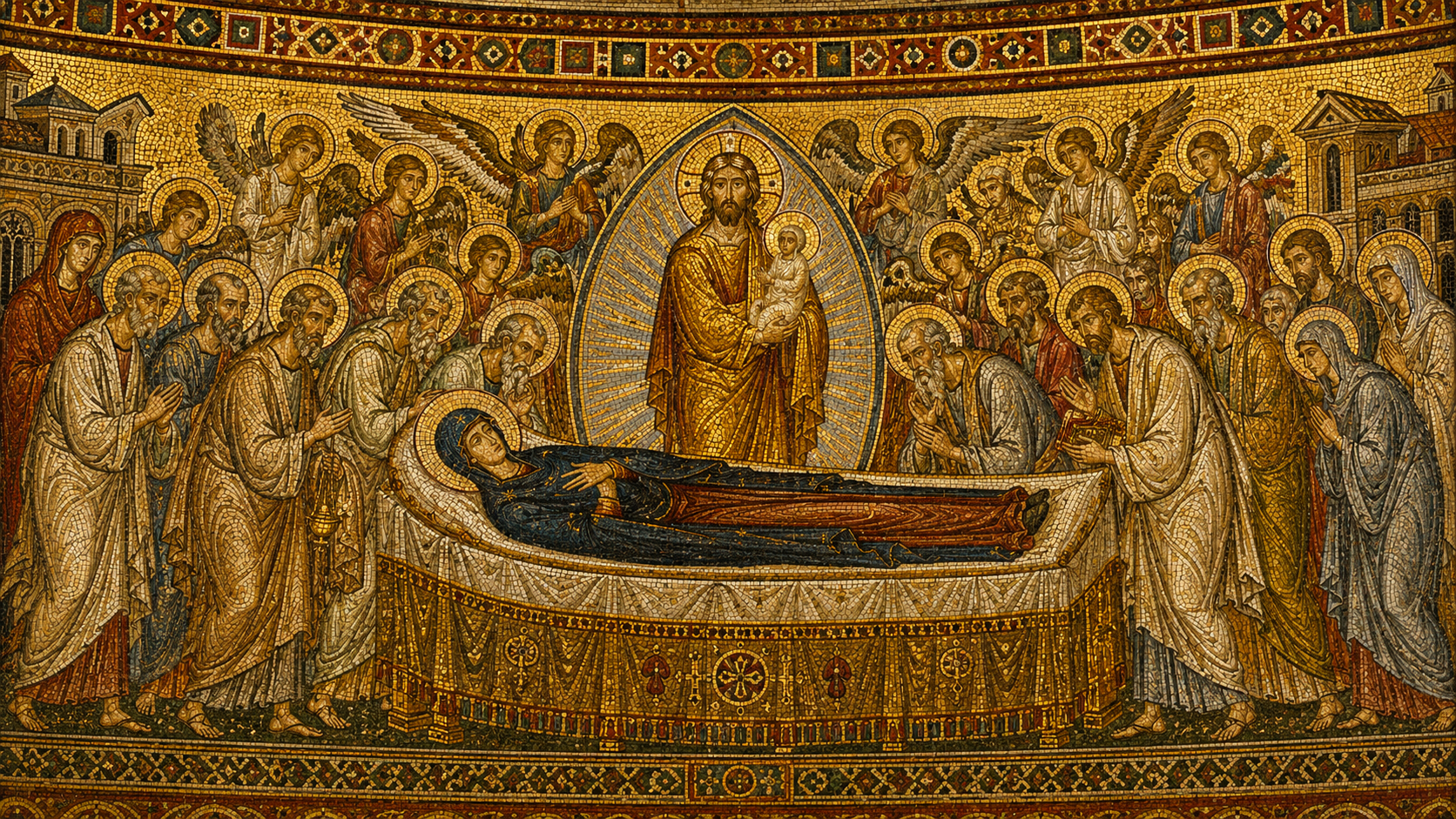
The Assumption is among the Church’s most ancient Marian celebrations. By the fifth century, Christians were marking Our Lady’s “birth into heaven”; in the Byzantine tradition the feast became known as her Dormition, or “falling asleep”. It was being celebrated in Rome by the middle of the seventh century. What Christians had prayed and celebrated for generations was solemnly defined as dogma by Pope Pius XII on 1 November 1950. Pius XII chose his words carefully. Mary, “having completed the course of her earthly life, was assumed body and soul into heavenly glory” (Munificentissimus Deus, 44). The Assumption is not the Ascension with a change of cast. Christ ascended by his own divine power. Mary was assumed: received into heavenly glory entirely through the saving grace of her Son.
Body and soul
In the Apostles’ Creed, we profess belief in “the resurrection of the body” and “life everlasting”. Those familiar words contain an astonishing promise. Christianity does not teach that the soul escapes while the body is discarded like unwanted packaging. God created the whole human person. Genesis tells us that God looked upon his creation and found it “very good”. The Son of God took flesh in Mary’s womb. He worked with human hands, became hungry and tired, suffered in his body and rose bodily from the tomb. Our bodies may age, ache and become rather less cooperative than they once were. They remain part of the person whom God created and loves. The saints are already alive with God, but they still await the resurrection of the body at the end of time. In Mary, by a unique privilege, that promise has already reached its bodily fulfilment. She shares, body and soul, in the glory of her risen Son. Her Assumption is intimately connected with her Immaculate Conception, her divine motherhood and her complete union with Christ. Yet it also reveals the destiny promised to all who belong to him. The Second Vatican Council therefore calls Mary “the image and beginning of the Church” as she will one day be perfected. She shines before the pilgrim people of God as “a sign of sure hope and solace” (Lumen gentium, 68).
There is an “already” and a “not yet” at the heart of the feast. The promise has already been fulfilled in Mary. We are still travelling towards its fulfilment. But the destination is real.
Mary’s great song
Curiously, the Gospel does not show Mary drifting serenely among clouds. It shows her hurrying through the hill country to help Elizabeth. Having received the most extraordinary privilege imaginable, Mary does not sit down to contemplate her own importance. She goes to the person who needs her. Then Mary sings the prayer which the Church calls the Magnificat.
Its name comes from its opening word in Latin, Magnificat: “My soul proclaims the greatness of the Lord.” It is Mary’s great hymn of praise, recorded in Luke 1:46–55 and prayed by the Church every evening. To magnify God is not to make him greater, as though the Almighty needed our assistance, but to allow his greatness to fill our vision. The Magnificat is no soothing lullaby intended to keep the world asleep. Mary proclaims that God scatters the proud, casts down the mighty, raises the lowly and fills the hungry with good things. She sees history through God’s eyes. Wealth, status and self-importance do not impress him. He notices the poor, the overlooked and the person standing at the edge of everybody else’s photograph. Mary magnifies the Lord rather than magnifying her difficulties. That does not mean pretending our problems are not there. The fields really are dry. The fire danger is real. Families are worried, bodies become ill and hearts are broken. Christian praise is not make-believe. It simply refuses to allow fear, suffering or sin to occupy the whole horizon. God is greater. The Virgin Mary and the once-barren Elizabeth also remind us that God is not restricted by what appears humanly probable. He goes beyond our calculations. He surprises. He brings life where none was expected and hope where the ground appeared barren.
Heaven sends us back to earth
Looking towards heaven does not excuse us from life on earth. The Vatican’s reflection on the Assumption makes precisely the opposite point. Because we know our destination, we should become more attentive to the people travelling beside us, beginning with the weakest and most vulnerable. The Assumption sends us back to Elizabeth’s house: to the sick friend, the lonely neighbour, the anxious family, the hungry person, the newcomer at church and the person who needs visiting, welcoming or simply noticing. Mary’s glory does not take anything away from Christ. It reveals the greatness of his victory. Everything she possesses is his gift; everything she does points towards him.
What does the Assumption mean for us?
The Assumption means that our lives, our bodies and our acts of love possess an eternal significance. Ageing, illness and death are real, but they are not the end of the Christian story. Christ intends not merely to preserve a small spiritual part of us, but to raise and transform the whole person. It also means that hope in heaven must make us more faithful on earth. We cannot honour Mary’s Magnificat while ignoring the hungry, the lowly or the vulnerable people of whom she sings.
The practical lesson is wonderfully simple: magnify God, serve the person before you and do not surrender to despair. The emergency warning on our phones will disappear. The Church’s message remains. The ground may be parched, but our hope is not. In Mary, assumed body and soul into heaven, we see what Christ’s victory promises to his faithful people: not escape from human life, but its resurrection and fulfilment in God.