The Mass Has Not Ended
By Johannes
18 August 2026
A lay Catholic voice reflecting within the life of the parish
When I woke this morning, I found myself thinking about how we take the Mass into ordinary life and fulfil the mission in which we, as Christians, are all asked to share.
Then, during morning prayers, I asked for guidance. As my thoughts crystalised, I felt a shiver pass through my body. It has happened before, though not often. Perhaps it was simply emotion; perhaps something more. Afterwards, I sat quietly and the framework of an article began to form. It would be about the Mass, mission and Christ’s command to love our neighbour: about taking what we hear and receive in church into the untidy business of ordinary life. I wrote the article and completed the draft before leaving home. Then I went shopping.
While I was out, I decided to call at Currys on St Andrew’s Quay for a non-essential item. There was no pressing need. The household would have survived and Currys would not have sent out a search party. Yet, for no particular reason I could identify, I went.
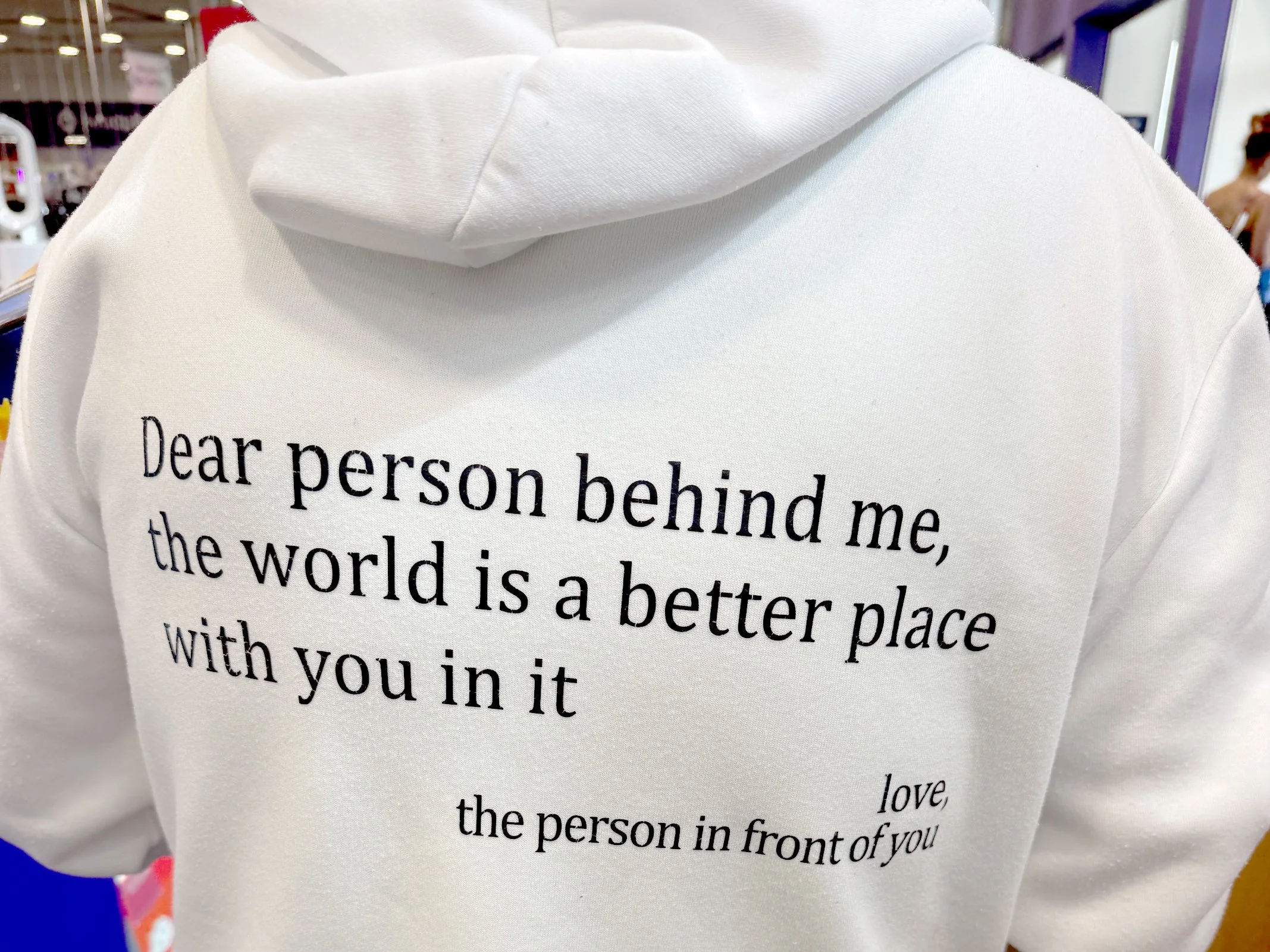
Standing in the queue to pay, I noticed the man immediately in front of me. He was wearing a white hoodie bearing these words across the back:
Dear person behind me, the world is a better place with you in it.
Love,
The person in front of you.
The inscription fitted perfectly with the article I had just written. I asked the man whether he was religious. “Not particularly,” he answered. Yet, he had gone to some trouble and expense to obtain the hoodie from America. Clearly, the words had resonated with him and whilst not a churchgoer, in a good degree his heart was pronouncing mission.
Was this meeting merely coincidence? Possibly. I have a friend, Mark, a lay preacher in the evangelical tradition. He calls such moments “nudges from God”. Faith is not built upon shivers, chance meetings or slogans on clothing. Yet God is not locked out of daily life. Providence is often quiet; sometimes it arranges a meeting in a queue. The man could not know whether the person behind him was cheerful, lonely, bereaved, frightened or merely cross because the queue was moving at the speed of a snail. He offered encouragement without selecting a worthy recipient or expecting thanks.
That looks rather like grace.
There is a danger in becoming very good at going to Mass. We know when to stand, sit and kneel, where the draught comes from and which hymn has too many verses. We hear of the sick being healed, sinners forgiven, the hungry fed and the rejected welcomed. Then we head for the door and disappear for another week. Fr Phil will soon give us the opportunity to come to Mass more often, as he plans to celebrate it on most days. That is a precious gift. But however frequently we attend, the story is not meant to remain inside the church. At every Mass, Christ gathers us around the table of his Word and the table of his Body and Blood. The sacrifice of Calvary is made sacramentally present, and the risen Lord gives himself to us. As Pope Benedict XVI wrote in Sacramentum Caritatis: “In the Eucharist Jesus does not give us a ‘thing’, but himself.”
Such a gift must change its recipient. Holy Communion is not a devotional hot-water bottle intended to keep us spiritually comfortable until next Sunday. We receive the Body of Christ so that, by grace, we may become more truly the Body of Christ in the world.
That is why one form of the dismissal tells us: “Go in peace, glorifying the Lord by your life.” The little word go matters. The dismissal is not the point at which worship stops. It is the moment when worship is sent through the doors wearing our shoes.
Pope Leo XIV expressed this beautifully at the Regina Caeli on 12 April 2026. He explained that the word Mass itself points to “sending forth” or “mission”. Christ’s Body and Blood nourish us so that we may become witnesses of his Resurrection. Pope Leo then said: “It is through the Eucharist that our hands become ‘the hands of the Risen One,’ giving witness to his presence, mercy and peace.”
The hands which receive Christ on Sunday are meant to become Christ’s hands on Monday: hands that welcome, mend, cook, clean, give and protect; hands that write a letter, make a telephone call or simply hold another hand in the dark. Mission can be organised. Christians establish food banks, visit prisoners, oppose trafficking, protect unborn children and support vulnerable mothers. Parishes bring Holy Communion to the housebound and help families in debt. Some wounds require many Christians working together. But most mission is quieter. It is refusing to join in when a colleague is being ridiculed. It is apologising without adding the fatal word but. It is treating the harassed shop assistant as a human being, noticing that a neighbour’s curtains have not opened, or listening to a child when we would rather look at our telephone.
These acts may appear small. So did five loaves and two fish. Jesus never separated love of God from love of neighbour. Asked which commandment was the greatest, he replied: “You shall love the Lord your God with all your heart and with all your soul and with all your mind and with all your strength.” He immediately joined this to a second commandment: “You shall love your neighbour as yourself. There is no other commandment greater than these” (Mark 12:30–31).
Asked who our neighbour is, Jesus told of a wounded man, two religious passers-by and a Samaritan who stopped (Luke 10:25–37). The Samaritan did not establish a working party to explore the feasibility of compassion. He bound the man’s wounds, took him to an inn and paid for his care.
Pope Francis wrote in Evangelii Gaudium: “Every Christian is a missionary to the extent that he or she has encountered the love of God in Christ Jesus” Pope Leo has carried that teaching forward. In his message for the hundredth World Mission Sunday, he writes: “If unity is the condition of mission, love is its essence.” We are not selling an ideology or recruiting for a religious club. We are sharing the love of God which has taken a human face in Jesus. There is a time to speak his name plainly, but our words sound hollow if our conduct contradicts them. Nobody is persuaded that God is merciful by a Christian who is habitually merciless.
In Matthew 25, those welcomed into the Kingdom are surprised. “Lord, when did we see you hungry and feed you?” The King replies: “Truly, I say to you, as you did it to one of the least of these my brothers, you did it to me” (Matthew 25:37, 40).
They had met the Lord in ordinary human need without recognising him. Perhaps that is the uncomfortable test of our Eucharistic life. Does receiving mercy make us more merciful? Does receiving the Prince of Peace make us less determined to win every quarrel? Does kneeling before Christ, hidden under the appearance of bread, teach us to recognise him hidden in the poor, the awkward, the tiresome and the wounded? Peter denied Christ, Thomas struggled to believe, and James and John wanted the places of honour. Christ still sent them. Mission is not reserved for the unusually holy or well organised. Baptism, not a laminated parish badge, is our commission.
At the end of Mass, Christ remains present in the tabernacle. Yet he also leaves the building in another way. He goes into kitchens and hospitals, offices and school gates, care homes, shops and bus queues, carried in the imperfect lives of his people.
The person beside us may never open a Bible. They may, however, read our patience. They may remember that we stayed when others slipped away, told the truth when a lie would have been convenient, or offered kindness when there was nothing to be gained from it. I had asked Christ for guidance, written the article and completed it before going out. Shortly afterwards, in Currys on St Andrew’s Quay Hull, its central message was standing directly in front of me. It did not give me the article; it felt more like an echo of what had already been written.
Coincidence or nudge? I cannot prove either. But perhaps the person who most needs to know that the world is better with them in it will one day find themselves standing behind us.