The Scared Heart of Jesus
12 June 2026
By Johannes
A lay Catholic voice reflecting within the life of the parish
On this Solemnity, the Church prays in a special way for priests, that their hearts may be shaped by the Heart of Christ — patient, merciful, faithful and courageous. But the Sacred Heart is not a devotion for priests alone. It is Christ’s invitation to every human heart: the wounded, the weary, the distracted, the doubtful, and yes, even those trying to reach Jarratt Street without losing the last shreds of Christian charity.
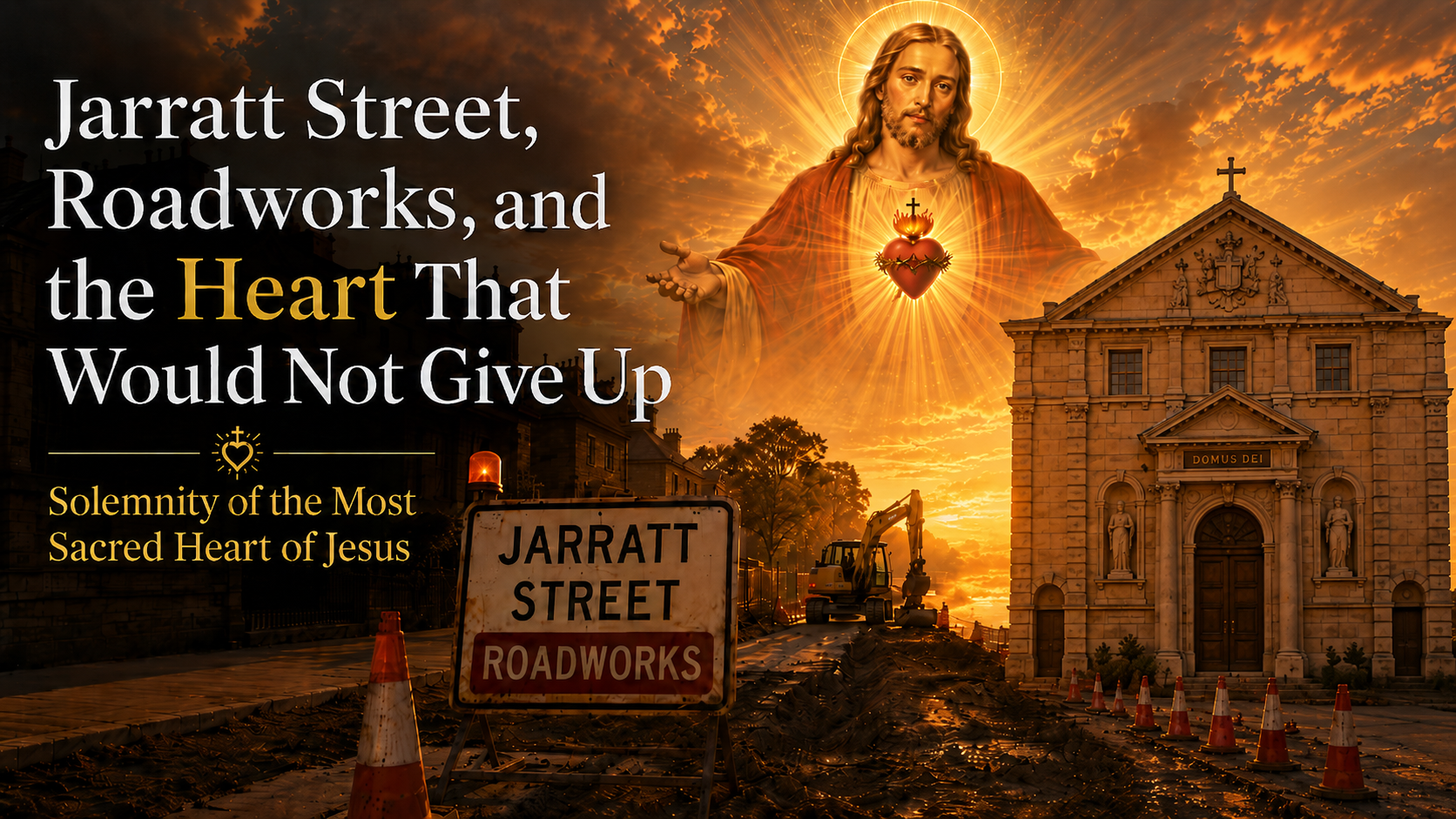
Oh yes, there are some moments in life when the Almighty provides the writer with a metaphor so obvious that even a man trying to park near Jarratt Street could not miss it.
Roadworks.
Not just roadworks in theory. Not the gentle, tidy kind of roadworks shown on council leaflets, where everyone is smiling, every cone is straight, and a man in a hard hat appears to be glancing meaningfully at a clipboard. No. I mean proper Hull roadworks. The sort where you set off with every Christian intention of arriving calmly, reverently and possibly even early, only to find half the street coned off, not a worker in sight, temporary lights having a nervous breakdown, and a queue of drivers all mumbling to themselves — not apparently in prayer, but with the haunted expression of people standing on the very edge of an emotional meltdown.
There is nothing quite like roadworks near church to test the condition of the soul.
One minute you are thinking holy thoughts about Mass and wondering whether to dig the brolly out of the car boot. The next, you are behind a van that has apparently taken a private vow never to exceed four miles an hour. By the time you reach St Charles, you have already examined your conscience, failed it, blamed the council, repented slightly, and wondered whether muttering under your breath counts as venial sin if the windows are closed.
And yet, perhaps this is where the Solemnity of the Most Sacred Heart begins.
Not in a perfect world. Not in a polished spiritual showroom. Not in a life where all the roads are clear, all the signs are obvious, and every heart is in excellent working order.
The Sacred Heart of Jesus comes to us precisely because the road is broken.
The feast is sometimes misunderstood. For some, the Sacred Heart can appear a little old-fashioned: holy cards, flames, thorns, rays of light, solemn statues, perhaps something remembered from childhood but not quite understood as an adult. Some may even wonder whether the image is too emotional, too devotional, too far removed from the hard realities of modern life.
But that is to miss the point entirely.
The Sacred Heart is not a religious decoration. It is not Catholic wallpaper. It is not a spiritual logo for people who like old hymns and polished brass. The Sacred Heart is the Church pointing to the very centre of Christ and saying: this is what God is like.
Not distant. Not cold. Not indifferent. Not a divine administrator processing human complaints from a safe height.
God has come close enough to be wounded.
That is the astonishing claim.
In Jesus Christ, God does not merely observe human suffering. He enters it. He does not issue sympathy from a heavenly office, glancing over our case notes between tea and an angelic committee meeting. There is no day off with an intergalactic sightseeing trip past the International Space station via Mars. No. He takes flesh, walks our streets, sits at tables, weeps at graves, feels rejection, carries the Cross, and opens His Heart.
The Heart of Jesus is not a metaphor for vague niceness. It is the living sign of a love that has gone all the way to Calvary and still has not turned bitter.
That is why the image of the Sacred Heart is so powerful. It shows a heart aflame, because divine love is not lukewarm. It is surrounded by thorns, because love is wounded by sin, cruelty, indifference and betrayal. It is marked by the Cross, because real love is never merely decorative. It gives itself. It sacrifices. It stays.
And that is where Jarratt Street in Hull may be more theological, and more significant, than it first appears.
Roadworks are annoying because they expose the fact that something underneath the surface needs attention. It might be a gas main. It might be something else. The top layer may look passable for a while. Traffic may keep moving. People may manage. But beneath the surface, things crack, shift, leak, weaken and decay. Sooner or later, someone has to dig down. And we know what that can mean. It’s not going to be pretty, and it is going to be a pain.
We prefer a quick resurfacing. A bit of spiritual tarmac. A tidy prayer. A comforting hymn. A vague intention to be better next week. We are quite happy for God to improve the view, provided He does not close the road.
But the Sacred Heart does not offer cosmetic religion. Christ comes to heal the deep places.
The resentments we have carried for years. The grief we keep sealed under polite conversation.
The shame we do not speak of. The anger that flares up too quickly.
The fear that we are not loved, not forgiven, not enough. The exhaustion of trying to look fine when the inner road has collapsed somewhere near the drainage system.
The Sacred Heart says: let Me in there.
Not because Christ wants to condemn us, but because He wants to restore us. The roadworks of grace are not punishment. They are mercy with a hard hat on.
Of course, we resist. We put up little signs of our own.
Road closed. Access denied.
No entry except for carefully approved topics.
God may proceed as far as Sunday Mass but must not interfere with family grudges, private anxieties, financial worries, old wounds, or the person I still refuse to forgive.
And yet the Lord waits. The Sacred Heart is patient. Not soft, not sentimental, but patient. He knows that human hearts cannot be repaired by force. They have to be won by love.
This is why the Sacred Heart is such a necessary devotion for our time. We live in an age full of noise, speed and surface. Everyone is reacting, posting, scrolling, judging and rushing. But the heart gets neglected. We know how to update devices, refresh pages, clear caches and restart routers, but we do not always know how to sit before Christ and say: “Lord, my heart is not well.”
The world tells us to toughen up. Christ says, “Come to me.”
The world tells us to perform. Christ says, “Rest in me.”
The world tells us to hide weakness. Christ shows us His wounds.
The world says love is useful only while it is successful, attractive, convenient and reciprocated.
The Sacred Heart says love remains love even when crowned with thorns.
That is the astonishing Catholic truth: God loves first. God loves even when we are unworthy. God loves when we are slow. God loves when our spiritual satnav has taken us past a city centre bridge under repair, through three diversions and into a one-way system of poor decisions.
And He does not simply love humanity in the abstract. That would be too easy. We all love humanity in the abstract. Humanity in the abstract never blocks your driveway, talks through Mass, leaves provocative comments on Facebook, or eats the last biscuit.
Christ loves actual people.
The awkward. The wounded. The difficult. The lonely. The devout. The doubtful. The cheerful. The permanently late.
The person in front of you outside the New Theatre who appears to be attempting a forty-seven-point turn while the opening hymn is already underway.
The Sacred Heart is not selective. It is not a private members’ club for the spiritually impressive. It is the Heart of the Good Shepherd, searching for the lost sheep — and anyone who has ever tried to find parking near church knows that being lost is not always a metaphor. Sorry to mention that again and note to confess the use of an expletive when I eventually get there.
But there is a challenge here too.
Devotion to the Sacred Heart cannot remain only a feeling. If we adore the Heart of Christ, we must allow our own hearts to be changed. We cannot kneel before a Heart burning with mercy and then live with hearts like locked filing cabinets.
The Sacred Heart asks us to become more like what we worship.
More patient. More forgiving. More truthful. More courageous. More tender without becoming weak. More faithful without becoming hard. More Catholic not merely in label, but in heart.
Because the Church is not renewed first by strategies, meetings, websites, newsletters or even very beautifully arranged noticeboards. Useful though all those things may be, the Church is renewed when hearts are brought back to the Heart of Christ.
That is where mission begins.
Not with panic. Not with marketing. Not with trying to look busier, younger, trendier or more successful than we are.
Mission begins when ordinary parishioners rediscover that they are loved by Christ and then begin to love others with something of His love.
A parish with the Sacred Heart at its centre becomes a place where people can breathe again. A place where sinners are not crushed, the lonely are noticed, the poor are not inconvenient, the grieving are not hurried, and the searching are not treated as a nuisance.
That does not mean everything becomes easy. Anyone who thinks Catholic parish life is simple has clearly never tried to organise a rota, source and arrange flowers, clean the church on a wet Saturday morning or practice hymns on cold winter evenings..
But the Sacred Heart gives us the only foundation strong enough: the love of Christ, poured out, wounded, risen and still present.
And yes, present above all in the Eucharist.
The Sacred Heart is not far away from the altar. The same Christ whose Heart was pierced on Calvary gives Himself to us in Holy Communion. The love that burned in His Heart is not locked in history. It is offered now. Quietly. Humbly. Under the appearance of bread and wine.
That is why Catholic faith is never merely an idea. It is an encounter.
We do not come to Mass simply to remember a loving God. We come to receive Him. We come with all our diversions, delays, damaged surfaces and hidden excavations, and Christ gives us not a lecture, but Himself.
So perhaps, while Jarratt Street is disrupted over the coming weeks, we might try a dangerous spiritual experiment.
Instead of merely sighing at the cones, let them preach.
Let the temporary lights remind us that sometimes grace says stop before it says go.
Let the dug-up road remind us that what is hidden still matters.
Let the diversions remind us that God can lead us by routes we would never have chosen.
Let the delay remind us that holiness is not usually instant.
Let the repair work remind us that mercy is not God ignoring the damage, but God healing it.
And when we finally arrive, perhaps slightly late, slightly flustered, and pretending we were calm all along, let us look again at the Sacred Heart of Jesus.
The Heart that was opened and never closed. The Heart that burns and is not consumed.
The Heart wounded by sin but victorious in love. The Heart that knows every broken road into the human soul. The world may offer temporary fixes. Christ offers restoration.
The council may eventually finish Jarratt Street.
But the Lord, in His mercy, is still working on us.
And thank God for that.
Amen.